Thursday, September 19, 2019

The motivations of anti-Masons

Someone on the subreddit for Freemasonry recently pointed to a Spotify podcast and suggested we all listen to it for a good laugh. I won't link to it and I didn't laugh. It was a fairly typical conspiracy theory of the type you'll see quite often, and which I address more fully in my Everything wrong with... Freemasonry posting from way back in 2014. But I want to talk about what motivates such efforts because it's not always immediately obvious. There are four sorts of anti-Masonic material out there (at least of the sort that get it all very wrong... someone who just thinks that what we do isn't okay... what's an honest difference of opinion and I take no exception to it).
  1. Ignorance
  2. Financial gain
  3. Saber-rattling
  4. Mental illness

Ignorance

Many anti-Masons find online materials like freemasonrywatch or various YouTube videos, presume that they are honest accounts and proceed to announce these "facts" to others. Often this is a self-feeding cycle, with videos based on videos based on podcasts based on blogs and so on...
I take no exception to the motivation, here, but I really do wish that when people read an extraordinary claim they would apply more skepticism and seek extraordinary justification before telling others about it.

I include in this category the sort of anti-Masonry that is meant to be humorous, but is executed in an ignorant way. I'm all for lampooning anti-Masonry (and Masonry for that matter) but when you simply pass on ignorance for the lulz, that's no better than the person introducing said ignorance in the first place.

Financial gain

This is probably the most common motivation of the prolific anti-Masons. YouTube and Patreon revenue are often enough to get people to keep coming back to anti-Masonry. It's exciting stuff and it brings in viewers. There's nothing that we can really do about this sort of anti-Masonry until the public becomes more selective about what it will entertain from content producers. But it is critical that we recognize it when we see it. These are not people who are simply mistaken about Freemasonry. They understand just fine, but they choose to spread falsehoods in order to sell books or get views.

Saber-rattling

This is very much like the above, but the motivation is the energizing of a base rather than direct financial gain. For example, a Catholic anti-Mason may seek to sway other Catholics to their sect or cause within the Church by attacking Freemasonry and suggesting that it's influencing "those other Catholics". This is not unique to Catholicism by any means. I've seen it from other religious groups, political groups and even some cultural/ethnic outlets. It boils down to promoting xenophobia for political gain, and as such I find it reprehensible and one of the darker things that humans regularly get up to.

Mental illness

I do not claim or suggest that someone who doesn't like Freemasonry is mentally ill. Disliking the thing I happen to like isn't a reason that I should suspect that you have a problem with reality, but there are absolutely many mentally ill people out there who gravitate toward Masonic and generally "secret society" oriented conspiracy theory because of their illness. It is critical that we Masons and the public in general not simply point and laugh at these behaviors. Mental illness is no laughing matter and if you cannot help such people in a constructive way, it is best to simply ignore them.

Examples of this sort include variations on the "mind control lasers" techno-paranoia for example.

Accidental anti-Masonry

Finally, there's a fifth type that isn't really anti-Masonry so I didn't include it... it sort of fits into the first category, but sort of doesn't. This is the bleed-over from various other conspiracy theory, some valid an some not. For example, there are many people who are concerned about abuse of power by police in many parts of the world and that conversation often ends up dropping in some anti-Masonry though it's completely unrelated for one of the reasons listed above, and then that connection ends up getting repeated until, almost without anyone having decided to do so, it becomes a central feature of many people's statements about the problem. This happens to lots of groups, not just Masons, and it's really just part of the game of telephone that we call modern society.

Conclusions

So, what can you do? For starters, be a better consumer of media. Don't pass things on because they're amusing if they hurt others or distribute falsehoods. Check sources and verify strange claims. I If someone says something that you find surprising check the details.

For example, if someone tells you that a woman sued McDonald's for serving her coffee that was too hot, look into the details... you might find that the facts of that case aren't at all what you thought they were, and maybe when you re-share that story, you'll give it some context...

Saturday, May 26, 2018

What does Freemasonry have to contribute to identity politics

The hot buzzword in modern pop-political philosophy has become "identity politics." As buzzwords go, it's not so bad. It clearly identifies its subject matter and there are real movements related to it. Feminism is one of the most obvious and often cited examples of identity politics, but there are many others from the gay rights movement to various ethnic rights movements, identity politics has been a mainstay of the leftist political landscape for the past couple of generations. On the right, things are a bit more complicated. Certainly, on the fringe there are identity politics movements, but outside of religious identity, most of these have not gained wider traction.

I should clarify a distinction between two types of identity politics: one is focused on dealing with overt and egregious oppression and one is focused on generally improving the role of and removing roadblocks for an identity group. The latter are really what this article is about, but in cases such as the civil rights movement in the mid-20th century US or the gay rights movement of the 1960s-80s, where there really isn't enough social equity to even open a dialogue, most of what I say toward the end of this article may not apply, or may apply in different ways.

Back to Freemasonry...

There are two obvious answers to the question: what does Freemasonry have to contribute in this realm? I believe that they are both wrong, but because they're such widely made arguments, at least in my own experience, I'm going to tackle them first and then move on to why they are wrong and what I think Freemasonry brings to the table.

Nothing

Because Freemasonry (at least as practiced in what most of the world considers "mainstream, recognized jurisdictions") explicitly disclaims any role in the political sphere proper, it is an obvious and, perhaps not entirely unjustified claim that we have no role in identity politics. We don't discuss politics in open Lodge; we don't use Freemasonry as a platform for our political advocacy; and our administrative apparatus (the Grand Lodges) are not politically active outside of their own internal structures.

We have always been here

Freemasonry, of course, has been what some have thought of as a nexus of identity politics for over 300 years! We're an all-men's organization (with some notable exceptions around "adoptive" rites and youth groups that are satellites of the main body of Freemasonry) and we have a strict requirement of a belief in a supreme being. We're arguably the oldest identity-oriented social structure in the West outside of religion (and perhaps some ethnicity groups in Europe). So it might seem obvious that we're not just able to contribute to, but are at the heart of the notion of identity politics.

Our Actual Role

But these are both misleading and ultimately untrue, though to different degrees. It's true that Freemasonry has no explicit role in the public political sphere, and this immediately tears down the second claim. But the first claim is only a part of the story.

Freemasonry has always had something to say about the translation of abstract philosophical ideas into the public sphere, through the transformation of the individual, and in this sense, it can speak to the dangers of identity politics and to the importance of identity perspectives.

First, let's talk about the dangers. Politics has a rough equivalent of the second law of thermodynamics: for every action there is an equal and opposite reaction. But the political equivalent is more nuanced. For every political position that is advanced in society, an opposing political position is empowered. This does not speak to equalities the way physics can, and that's because the thermodynamic-like properties of politics tend to be quite complex, and the A=B sort of equalities are quickly lost in diffusion through many competing perspectives.

We do know, however, that political movements empower those who are inclined to disagree with their aims (as might seem obvious). This means that creating an identity-focused political movement tends push fringes that oppose that view further into the mainstream. So, when women, for example, advance deeply women-focused political ideas such as feminist epistemology, fringe men's rights groups that were otherwise not taken seriously by the mainstream right begin to advance into the light of day.

But Freemasons have long known that a shared group identity can give an organization a profound capacity to give its participants new perspective on their situation. The reactive men's groups that form in response to feminism, for example, are not going to be focused on improving their capacity to support women's needs in society to equality and dignity, but as a group that affirms the value of the individual, Freemasonry can inspire men to contribute in those areas (as much more eloquently put by Wor. David Riley), thus improving both their own situation and that of women.

What we have to contribute to modern identity politics is a 300+ year old perspective on what works and what doesn't in seeking to improve society by improving the capacity of the individual to reflect on their role in that broader context, and any identity group that takes on that, much more complex and difficult challenge is going to find that the inherent resistance created by advancing agendas based solely on an identity do not go away entirely, but they are substantially reduced.

In short, what Freemasonry has to contribute to identity politics is a way of accomplishing the same goals, within the same groups, but without having to be oppositional. As a men's group Freemasonry does not need to oppose women and women's rights, nor do individual Freemasons. As a faith-oriented group, Freemasonry does not have to oppose atheists, nor do individual Freemasons. And as a continuance of Western ideals, Freemasonry does not have to oppose the vastly expanded interactions in our modern society between East and West, and indeed, many Freemasons have helped to enhance the value of those interactions.

Monday, September 18, 2017

Is Freemasonry a Good Career Move?

I'm often confronted with variations on the assertion that Freemasonry is a business networking opportunity. Let me be clear: it's not. But there's a related question to which the answer is more complex, and I think Freemasons don't promote this question enough: is Freemasonry good for your career?

To this, I give an unequivocal "yes". In fact, it's a great career move for many reasons, some of which I won't get into, here, such as the role of self-knowledge in professional life. They're all useful topics, but for now I'll just stick to the simple question of why you might get hired for a job because you're a Freemason.

Now, if you're thinking, "the hiring manager might be a Freemason, and so they'll hire me," then stop right there. Not true. First off, the hiring manager almost certainly isn't a Freemason. Since the 1960s, membership in Freemasonry has declined substantially, and there's no reasonable case to be made that one should expect to run into a fellow Mason at work. There are probably on the order of 100 Freemasons in my city whose work plus residential population is probably around a half a million. That's 1 in every 5,000 people you might run into that are going to be Masons. Good luck with that.

So why, then?

Because the Masonic Lodge is one of the most profoundly impressive leadership training systems in the world, even though far too few people within the Fraternity seem to realize this, or at least the avoid talking about it.

Think about it: you spend somewhere around 7 years (depending on jurisdiction) learning every facet of running the Lodge, from setting up the tables and regalia to organizing the caterers and candidates. Then you spend a year or so actually being the executive management in charge of the Lodge. You have to learn how to work with a Secretary and Treasurer to actually run the business of the Lodge. You have to learn how to manage volunteer labor. You need to learn what works and what doesn't when it comes to getting work out of people.

These are not just relevant skills, they're the kinds of skills that the majority of people will never learn! I know of less comprehensive programs that are entirely based on simulation and classroom work that cost a fortune! But Freemasonry tends to cost less than going to see a movie once a month and gives you a fully rounded experience. Is it draining and demanding? Of course it is, but it will be when you do these things in your professional life, and learning to balance professional and personal demands is yet another part of the lesson.

So that brings us to how you sell yourself on this basis. How do you tell an employer? Well, here's what I wrote up recently to answer that very question:

Saturday, August 13, 2016

Experiential communication

One of the hardest elements of Freemasonry to communicate to others is what it communicates. There are parts of the communication that are easy to understand. You can read exposes of the degrees online. You can chase the historical, philosophical, religious, educational, literary and technical allusions that they have to offer, and spend a lifetime in doing so. You can listen to lectures on their deeper meanings on YouTube and read the dissection of them by notable Masons, scholars, enthusiasts and raving conspiracy theorists alike.

All of this will have varying amounts of return on the investment of your time, and to some extent I think it would be worth doing for the person who is not and feels they never will be a Mason.

But after all of that study, you still won't understand what Freemasonry communicates!

That's a kind of bold statement, and it really does need to be defended, so let me first explain some technical details before I circle around to defending my claim.

In the 1960s, a man by the name of Noam Chomsky developed a startling linguistic theory. His theory, backed up by the first successful mathematical approach to all languages, demonstrated that all human languages together only covered a small subset of possible languages that might be developed.

From this arose the popular idea that even the set of all possible languages has its own limitation on expressing all possible ideas.

If we take that as given, then my statement about Freemasonry becomes a bit clearer. What I'm really asserting is that, while language cannot communicate certain ideas, the combination of language and an experiential setting that goes with it gives us the ability to communicate ideas that we cannot then divulge to others without the same combination of language and experience.

I call this "experiential communication," and it has been the secret hidden in plain sight of Freemasonry for hundreds of years. In fact, it is one of the hidden secrets of all initiatory organizations, religions, orders, societies and so on. Not all of them are communicating the same ideas, though. Obviously a Christian baptism is seeking to communicate something different from a Masonic initiation, but both are ideas for which language is (in my opinion) insufficient and always will be.

But, I hear the careful reader saying, "you said that this was true only if we took as given that there are ideas which cannot be expressed through language." This is true. And it should never be taken as an absolute given that what we Freemasons claim to communicate is truly impossible to communicate any other way. But what I will say is that, thus far, I have never even come close to finding a way to do so. I could write for ages on this blog about how I feel "connected" to the Brethren of my Lodge or how the degrees evoke a gestalt that I can't quite put my finger on and has lead me to a deeper and more intuitive understanding of the philosophies and other ideas that the degrees connect to.

But ultimately we come to the fact that I can never tell you what it is that I can't tell you.

Sunday, March 27, 2016

The position of the Grand Lodge of Franklin with respect to recent developments in Georgia and Tennessee

Sunday, March 27, 6016 AL

Worthy Brethren,

Since its founding in 5784 AL (1784 by AD reckoning), the great State of Franklin has been seen world-wide as a symbol of the universal love and harmony espoused by our namesake, M.W. Benjamin Franklin. But in recent days, that harmony has been sorely tried within the distinguished halls of Freemasonry. A rift has appeared in our ranks over the interpretation of scripture and its relevance to our Craft. Specifically, the VSL which is a Great Light of Masonry here in Franklin admonishes a man not to "lie with mankind, as he lieth with a woman," so there can be no doubt that such an act is in contradiction of the moral principles of our Craft... or can it?

We cannot fail to acknowledge that not all Christian orders within our sovereign jurisdictional borders concur with this assessment of the Holy Bible and more relevant, the Grand Lodge of Franklin has many a worthy Brother who are not Christian. Even within other Abrahamic religions, conservative Judaism, for example, has ordained homosexual rabbis and obviously this Grand Lodge is in no position to question their practice of their own faith.

Rather, this Grand Lodge takes the position that these are matters of sectarian religion and of profane politics. The purpose of a Grand Lodge is to oversee the regularity of the work of its Lodges and to represent their interests in the larger community of Freemasonry. That role does not require us to peer into men's bedrooms or to adjudicate their creed. Indeed to do so would rightly be deemed un-Masonic as it tears down one of the most fundamental of Landmarks: the universality of Freemasonry; that we do not accept or reject the political or religious views of the Brother we sit next to in open Lodge, but rather love him for the Brother he is, regardless of whether we agree or disagree in the profane world.

But our good neighbors in Tennessee and their neighbors in Georgia have taken such a position. As such a call has been made from some quarters for us to suspend recognition of these two Grand Lodges. We will not take such an action. To do so every time we believe a Grand Lodge has strayed from the Landmarks would result in a state of uncertainty on the part of all Franklin Masons. Rather, we will selectively fail to recognize the suspension or expulsion of any Georgia or Tennessee Mason for the sole reason of their sexual orientation or marital status. Any such Brother, being deemed worthy in the eyes of the Grand Lodge of Franklin by a committee to be appointed, shall be given honorary status as a Brother in this Grand Jurisdiction, should the Brother so desire.

This leaves the choice of recognition entirely in the hands of those two Grand bodies. Should they desire, they can suspend recognition of Franklin over what I am certain they will see as a violation of our jurisdictional rights. This is their choice, and we will not question their right to take such action, should they deem it necessary.

However, let us always remember that Freemasonry is about more than our inter-Grand Lodge politics. Freemasonry aims to make good men better, and as such we will now return to our Craft with the hope that we can proceed with that more sublime task and leave this issue in the background where it belongs.


Fraternally,

Washington C. R. Frater,
Grand Master
Most Allegorical Grand Lodge of Franklin

Thursday, March 24, 2016

Beyond conspiracy

I think that there comes a time in the career of every Freemason who earnestly pursues the Craft where he will focus on conspiracy theory and anti-Masonry in general. It's an itch... an irritant to any man who feels strongly about the good we do, and we want to explain to others why these ideas don't work. I still do that to some extent, but I've crossed a Rubicon of sorts.

A month or so ago, I engaged a conspiracy theorist directly online and he became... unreasonable. It ended in death threats from him, and I disengaged completely, of course. But it forced me to ask why I cared what he thought in the first place and what my goal was in engaging him in debate.

I think that it has become time for me to return to Freemasonry for its own sake, rather than trying to counter the antis. Yes, I'll continue to respond here and there if I really feel that there's value, but that will be much rarer and this blog will probably return to a more directed investigation of those six ideas that I brought up in the very first posting, here: Brotherly love, the spiritual bond of Freemasonry, the eternal edifice of the Fraternity, a sacred duty to mankind, stewardship of the past and present and  the allegories and ritual of Freemasonry and their meanings.

To that end, I'm going to put off part 2 in my Use of Knowledge series of articles and tackle a different set of ideas first. Expect to see a new series begin in the next couple of weeks about taking on responsibilities within the Fraternity. I've really been deep-diving into taking on responsibility and I think I have something to say about that that's more than just a surface-idea.

Thursday, March 3, 2016

Use of knowledge, Part 1: Pike on Lucifer

One of the most common quotes that conspiracy theorists bring up, and one of the most confusing to Masons is Albert Pike's comments about Lucifer in Morals & Dogma, which go:

Lucifer the Light bearer. Strange and mysterious name to give to the Spirit of Darkness. Lucifer the Son of the Morning. Is it he who bears the Light and with its splendors intolerable blinds feeble sensual or selfish souls? Doubt it not!

Now, Pike is a scholar of esoteric interpretation of the highest order, so I'm absolutely unqualified to fully unpeel that, and the context from the book and from the degrees is certainly necessary, but here's my personal views just based on the quote alone:

Lucifer the Light bearer.

This is simply a translation of the Latin word, derived from lux ferre which literally means "to bring light". There's no interpretation at all, here.

Strange and mysterious name to give to the Spirit of Darkness.

This isn't all that deep, interpretation-wise. It is strange that the spirit of darkness has a name which relates to Light. In the Bible, Light almost always refers to the divine, starting in the very first passage of Genesis.

Is it he who bears the Light

Now Pike is getting into deeper symbolic waters. He's introducing the double meaning of "Light" both in the sense of the Bible and the history of the Western initiatic tradition where Light has generally referred to knowledge and understanding. So, this amounts to (if I can so boldly pare Pike down to modern lingo), "if Lucifer is the light bearer and we talk about Light all the time, WTF?!" and he continues...

and with its splendors intolerable blinds feeble sensual or selfish souls? Doubt it not!

Okay, so here's the punchline. You have this idea that knowledge and understanding come with this spirit of darkness. Is that true? Of course it is! Look at any aspect of life from physics to personal relationships. The more you truly understand, the more you are entrusted with potentially harmful capabilities. Physics can give you the key to solving the world's energy problems or building a bomb of horrific potential. Understanding personal relationships can lead you to helping others or to Red Pill-style manipulation of them.

So my own interpretation, here, is:

The Mason is engaged in a quest for knowledge and understanding, but beware: what you bring to that process is your moral compass, and those who fail to apply that compass and seek "feeble, sensual or selfish" ends will undo all of the work that they have done to get there and end up with nothing (being "blind" to the Light).

Doubt it not, indeed.

Sunday, February 28, 2016

When he holdeth his peace, is counted wise...

Conspiracy theorists often forget that by speaking out about something that they understand only superficially, they confirm their lack of understanding to the rest of the world. The most common example of this is the assumption that Freemasonry has a single organizational structure either in terms of its governance or the progression of degrees. When I tell them the truth, they are either left speechless or assume that I'm lying because it immediately disarms their entire rationale for despising the Fraternity.

But this is only the most common example. Interpretations of symbols is another common case where conspiracy theory goes off the rails. For example, a recent "Above Top Secret" posting analyzed the art of Freemasonry. Its conclusions were absurd, but it's important to understand why they're absurd. It's not because they're wrong. In fact, an argument could be made that they're not wrong because there's no such thing as "right" when it comes to interpreting Masonic symbolism. At best, one has a better claim to understanding the symbolism if one has been initiated, but that's only because they symbols are intended to relate to the initiatic experience.

So, here are a few examples from that article:

The compass and square ... As we can see the compass (Female) is on top of the square. Indicating that the female is the Stronger of the sexes.

First off, the interpretation of the Compasses (compasses is never singular) as female is arbitrary. I could make an argument that it does represent the female, but it's a thin argument (based on historical associations of circular vs. squared shapes in art). It's certainly not a slam-dunk assertion that this is the correct interpretation of that symbol.

As an example let me provide a second interpretation: the square is a tool for measuring the real world. Is this stone square? Let's check... But the compasses are a tool for measuring intent. You use them on paper to lay out abstracts. The abstract is above the concrete (no pun intended) because this is how we view our metaphysical situation.

That's my interpretation, but it's not "right" either. There is no right interpretation.

The all seeing eye is in actual fact. The Holy See. The Vatican. Because Freemasonry is just another extension of the Vatican.

This one is fairly silly, but I'll point out that this is contradicted by the fact that the Catholic Church has, in the past, sentenced Freemasons to death for their association with the Fraternity and still considers membership in the Fraternity to be a "grave matter" (otherwise known as a "mortal sin," preventing the Mason from receiving communion).

Another side point, the correct name for the "all seeing eye" is actually the "Eye of Providence" and it is not merely a Masonic symbol. Centuries before it was used by Freemasonry it was a symbol of the Christian conception of divine providence. It later became a generic symbol of the omnipresence of deity, and that is why Freemasonry alludes to this symbol.

[In the artwork depicted] The leaves represent fractals.

Fractals are a concept that really were not fleshed out until fairly late in the 20th century, and even their initial introduction as an abstract concept wasn't until the late 19th century. Freemasonry has been around for at least 200 years longer than that, possible 3 or 4, depending on how you measure and which historical evidence to take as indicating the existence of something that could reasonably be called "Freemasonry."

Symbols do not have to have just one meaning. It is what makes them so interesting.

This is the only insightful comment in the article, and yet the author does not appear to understand it...

There are 33 degrees in Freemasonry. Because there are 33 vertebra in the Human spine.

This would be fascinating... but there's a problem. There are many more than 33 degrees in Freemasonry. There are 33 degrees in the Scottish Rite... well, that's not strictly true, but there are 33 numbered degrees. But they're broken up into a sequence that has no mapping to the spine. As a result, I'm inclined to assert that this is a coincidence only, but there's certainly room for allegorical ideas about the spine and the Scottish Rite due to the presence of this coincidence. It just can't be treated as a sole interpretation.

Unfortunately, this is the point at which the author lost their own thread and started trying to interpret the sacred art of various world religions instead of the art of Freemasonry. It's sad, really, because it punctuates what might have been a passable attempt at giving one interpretation of the symbols of Freemasonry with what amounts to a rambling torrent of gibberish ranging from the Apse of St. Peter's Basilica to Levi's Baphomet (not a Masonic figure at all until it was associated with Freemasonry by the Taxil Hoax) to the Swastika to the Yin/Yang to various random examples of sacred geometry.

In general, here's a good rule: Even a fool, when he holds his peace, is counted wise. (Proverbs 17:28) If you are not certain that what you know is true, it is best not to say anything, but if you must, do not say it with an air of veracity and authority.

Friday, January 22, 2016

What is initiation, why is it secret and how does society benefit from it?

The Initiation Chamber
Villa of the Mysteries, Pompeii
I've made the outrageous claim before that society makes great strides when the initiatic tradition is intact and widely adopted and that civilization suffers when this is not the case. In order to even begin investigating the validity of that claim, we need to understand what it is we mean by "initiation" and how it works. This is the goal of the present article.

So, what is initiation? In its simplest form, it is the recognition of entry into a new role or subculture in a larger society, using a system of ritual, performed exclusively by those who have previously been initiated.

Let's look at some examples to clarify what that means: When a man is going to be married, most Western cultures have some sort of ceremonial celebration at which the man is prepared for his new role in society as a husband. In the US we usually call these "bachelor parties." Similarly, when one joins the military, there are many distinct rituals of bonding and acceptance performed as a part of "basic training."

Within the societies which perform stand-alone initiations such as Freemasonry, Rotary and so on, the role of the initiation is not merely a demarcation which one experiences and then moves on. It is an entry into a fellowship, but the process is still very much the same.

We now have a sense (if only by example) of what initiation is, so why is it almost always secret?

Certainly, there are elements of many initiations that are considered private matters (bachelor parties might involve watching a "stag film" or, more commonly in the modern day, hiring an exotic dancer; military initiations might be considered violent by outsiders; etc.) but this is not the primary reason for secrecy.

Rather, secrecy is a part of the reason for initiation. Forming a hidden "token" of belonging between the initiate and the existing members of the group makes the act of initiation meaningful. We see this in every trivial act of initiation from the proverbial "keys to the executive washroom" to the programming communities where contributors who have been accepted into project are given permission to submit new source code.

This gives us a reference point from which to begin to talk about how initiation benefits the individual, the group and society at large.

For the individual, initiation is a signpost. Before and after initiation one leads different lives: the exoteric and the esoteric. By creating and valuing an esoteric context, we promote the notion that there is meaning and value in belonging and contributing to something which is more than just the sum of its individual members. This idea, in turn, is the hallmark of functioning societies.

To quote Yeats' poem, The Second Coming, "The best lack all conviction, while the worst are full of passionate intensity." It is this lack of conviction on the part of those who have the most to contribute which initiation is meant to address and resolve; not simply by bonding the initiate to the existing members, but by bonding them to the initiatic body itself and teaching them that they can add value to their cultural context by seeking the acceptance of their peers.

In a future update, I will address specific historical examples of societies with and without strong initiatic traditions....

Thursday, January 21, 2016

The Eye of Providence, Freemasonry, Illuminati and the Great Seal of the United States of America

Last Supper at Emmaus
Jacopo Pontormo, 1525
There's a great deal of misinformation around the eye in the triangle symbol and what it means. I'd like to clear that up. FIrst off, it's called "The Eye of Providence."

The Eye of Providence inside of a pyramid is not "the Illuminati logo". The symbol of the Illuminati was the Owl of Minerva. The Eye of Providence was a symbol of the Christian notion of divine providence circa the 15th century in art, but was adopted by many different organizations in the 17th and 18th century as a symbol of the omniscience of deity without being specifically of any one religion.

It was in this sense that Freemasonry, not the Illuminati, used the symbol (though, also not as their primary symbol or logo, which was the Square & Compasses), but it did not appear inside of a pyramid. The conflation with the pyramid probably arose from The Great Seal of the United States where the Eye of Providence represents the providence of God with respect to the founding of the nation from 13 individual colonies (hence the 13 stones making up the base of the pyramid). This providence is clearly explained in the Declaration of Independence, where it is clear that one of the most important aspects of the founders' claim to the right of self-rule, in the face of centuries of monarch-lead claims of divine right to rule, was divine providence. But note that the eye is not inside a pyramid on the Great Seal either! It's actually inside of a triangle. We'll get to where the eye started to go in a pyramid later on...

The Great Seal, like many other uses of the Eye of Providence in the 19th century, had little to do with other uses, so much as it generically represented the philosophy of one group (the framers of the early US system of government). Was it used because of Freemasonry's use? Probably not, but we can't know for sure. Freemasonry was one of many groups that routinely used that symbol in the 18th century, and it was probably used more to avoid specifically referring to any one group or philosophy than the opposite.

The eye is routinely associated (by conspiracy theorists as well as well-meaning enthusiasts) with the Eye of Horus, a symbol from ancient Egyptian mythology. The problem with this theory is that there is absolutely no evidence to support it, and the eye as a symbol of the awareness of deity has cropped up in many isolated systems of iconography from Eastern religions such as Hinduism to the Western aboriginal folk art. There is therefore no particular reason to assume that the Eye of Providence had to be based on some previous icon, and there is no evidence to cause us to do so.

So, why are we so convinced that the Eye is a symbol of the Illuminati and that it was displayed inside a pyramid? Well, that all gets to a funny little thing that happened in the 1970s. Robert Anton Wilson published a story called The Illuminatus! Trilogy which was a comedic, science fiction take on just about every brand of conspiracy theory, and it based its titular organization on what had been a relatively obscure bunch mostly of interest to historians for their alleged influence on the later Jacobins: the Bavarian Illuminati. The book developed most of the sorts of memes that we're familiar with today regarding the Illuminati including absurdly broad influence over governments, religions and secret societies; contact with aliens; the whole works!

It also featured on its cover the Eye of Providence inside of a pyramid... probably influenced by the Great Seal.

The Eye of Providence is an important part of the history of post-enlightenment symbolism and it's sad to see so many people ignoring its actual history in favor of comedy/sci fi. I love good sci fi, but I try not to confuse it with history.

Tuesday, January 19, 2016

Faith and the Craft

Ian Edwards'
Leap of Faith
We use the word "Faith" all the time as Masons. It's a part of the lessons of the first degree, but how many of us think about what the word means?

Obviously, faith can refer to a belief in deity, but I think that Freemasonry uses it more specifically than that. When we use the word, I believe that we are very particularly talking about the acceptance of and trust in the idea that the world is not simply random. That is, that being of good character and seeking Light has meaning. None of the other lessons of Freemasonry have any value whatever without this foundation, so it must be accepted by the new Mason before he can even proceed to be obligated as an EA.

Let's look over some of the definitions that others have used and compare to this analysis.

Mackey's Encyclopedia of Freemasonry defines Faith as, "synonymous with confidence or trust, and hence we find merely a repetition of the lesson which had been previously taught that the first, the essential qualification of a candidate for initiation, is that he should trust in God." Note that he points out that it is this "trust in God," not just a belief. It is the faith in, "evidence of things not seen," which allows us to accept that we, our Brothers and the lessons of Freemasonry have merit and meaning.

We also direct the Worshipful master, in the Charge as given in Webb's Illustrations, to a "diligent observance of ... the Holy Scriptures, which are given as a rule and guide to your faith." Again recall that the VSL is a symbol, representing the scriptural dogma of a given Brother's belief. It is this faith in the codified meaning of one's beliefs, handed down through generations that the Brother who has attained the Oriental Chair is admonished to observe. Not because there is a dogma which Freemasonry is advocating, but because it is that faith in the continuity of the wisdom from which Freemasonry derives which enables our Craft to proceed with their work.

Monday, January 11, 2016

Is This Your Work? The Journey of a middle-aged, young Mason


In 2012, I was part of a local gaming group. We played a variety of games including some of the euro-import board games and various roleplaying titles, usually focused on rich story and political intrigue. One of our gamers was a really interesting character. He was a former rabble-rouser and very politically aware and active liberal guy who also happened to be gay. All of this may seem irrelevant, but it formed a picture in my mind of who he was and how I expected his life to be.

Then that all changed. One day, he told me he was a Freemason. "Wait... what... you?!" I must have asked with some obvious incredulousness. Yes, he was one of those old guys that sat around talking about Elizabethan politics over brandy and a cigar... or at least that's what I thought Freemasons were when they weren't out driving their clown cars.

This drove me to learn more. I started studying Freemasonry a bit and asked casual, low-key questions every now and then, trying not to step on any need for secrecy that would prevent his answering further questions.

This was at a time in my life when much had changed. I'd come out as bisexual to my friends and family over a decade before, but the process is never quick or simple. One of the more unexpected and tangential results of that transition was a change in my beliefs. I'd always called myself an agnostic. I didn't deny the existence of God, but neither did I think that there was likely an old man in the clouds waiting for me to pray to him. I had no particular faith, but more and more, as I questioned my role in society, I also questioned my role with respect to existence.

That all came to a head as I investigated Freemasonry. I started reading about men like Ben Franklin who identified as deists, and I looked into their beliefs. The classical deists were more or less Abrahamic theists without the dogma and generally held to a non-interventionist view (e.g. no miracles).

I thought: if this Franklin fellow could be a Freemason and hold more or less the same view that I do, why can't I?

So, I approached my friend and asked about joining the Fraternity and how one went about doing so? Did he have to ask me or could I just fill out an application?

I was invited to the Lodge and given a tour. My silly questions were answered and maybe I asked one that wasn't... I don't remember, but I know I asked about why women weren't in the Fraternity and why there were secrets and whether anything I'd be asked to do or take an oath to would violate my conscience... all of the usual stuff.

He reassured me on every point that this wasn't the kind of group that someone like himself would have any problem with, and so I was unlikely to be concerned, but that Freemasonry isn't a prison, and I was free to turn around at any time.

With this assurance, I took my first step. I came back for an interview and the application process a little while later and then panicked over whether or not they were going to reject me... it took so long (probably a month or two, but I was really wound up about it at the time).

In the end, my journey as a Mason began the way all of the worthy Brothers before me have begun: with that first step forward to the door of the Lodge room.

After my initiation, my mind was swirling! There was so much there! There was morality and philosophy and history and a kind of art that I had never experienced before! Like every earnest Mason after that first degree, I was overwhelmed and, of course, I'm still unravelling that experience today.

What struck me most in joining the Fraternity was not just the eagerness to have another set of hands... I expected that, but the eagerness to teach, to discuss, to puzzle out the nature of our work. This is now my work, and it will be judged by future generations, I suppose. Is it good work?

Wednesday, December 23, 2015

How many Masons are there?

It's a simple question: how many Freemasons are there in the world/US/wherever. The statistics can be hard to gather. You'll hear numbers like 6 million or 5 million, but these numbers don't give a clear picture. I can clear this up a bit...

As you can see, the graph looks rather stark. The decline in the US that we hear about and are often told began in the 1970s or 1980s actually began in either 1960 (total number) or 1955 ("per capita" or fraction of the total population of the US). Why are these different? As with most questions regarding the US population in the 20th century, the answer involves the Baby Boomers, WWII vets and the changing landscape of our culture in the 1960s.

But starting in the 1960s, even the WWII vets couldn't prop up the numbers any longer and the fact that the Baby Boomers were not joining in the same numbers as their parents became clear. Over the next 40 years, the decline was as steady as a heartbeat. It was only in the 2000s that the number began to show signs of leveling out, but of course, by this point the numbers were radically declined, and it's possible that there are just dynamics of a smaller population that take over.

But there are some interesting hints in the data. The existence of an existential threat that both unifies the population and encourages it to view its history with pride seems to have a significant effect on membership. Notice the drastic change in trajectory between 1940 and 1942. The numbers hadn't changed much, but the trajectory went from a major slide down to a sharp spike up!

But is membership all we care about? It's nice to have the money that comes from 4 million dues-paying members, but is it necessary? I don't think that it is. We're a link in the chain of the Western initiatic tradition. Ultimately we will contribute to the next link in that chain and they to the next and so on. What is critical is that we maintain a sense of why that chain is indissoluble for long enough to connect to whatever comes next; to pass that wisdom on to the Academy that will teach the next generation of seekers. Will that be in 5 years or 50 or 500? There's no way to know.

Wednesday, October 14, 2015

Honest Trailer: Freemasonry

Symbols often obscure the
discussion of Freemasonry
with non-Freemasons.
Continuing the trend from my previous article, Everything Wrong With... Freemasonry, the title of this article also refers to a popular YouTube movie review channel, but this article is equally as serious as the first. Previously, we discussed the anti-Masonic claims, but I suggested that I would also write about what Freemasonry really is and give a positive perspective, rather than just disclaiming the negative. That is the goal of this article.

So let's begin at the beginning. Most attempts to summarize the benefits of Freemasonry fail to be coherent or are overly simplistic. Typically they are in the form of vague language such as "Freemasonry is a system of morality," or, "Freemasonry teaches a set of moral lessons using an abstract and symbolic language." To the uninitiated, this sounds not only strange, but arguably like the doublespeak of a cult, and I think tends to alienate more prospective members than it attracts. Instead, I'm going to try to break down what kind of people would be interested in Freemasonry, what kind of people would not and what the former would get from it in simple language without using vague terms like "system" or arm-waving at what we do by calling it "lessons."

First, some basics so that we're all on the same page: Freemasonry is a fraternity. You've probably heard this, but it's probably a less useful term than we might hope. The term has come, primarily, to refer to the Greek system of fraternities on college campuses. These organizations are, to some extent, modeled on Freemasonry but they are not Masonic bodies and their goals can vary widely. Instead, Freemasonry is a fraternity in the sense that it is a social organization of men with a common set of interests.

Freemasonry is also an initiatory body. That is, we have an initiation ceremony that must be undergone before one can become a member of the organization. This initiation is broken up into three parts: the Entered Apprentice degree, the Fellowcraft degree and the Master Mason degree.

Each degree teaches a set of philosophical ideas that are deeply entwined with the notions of deity, charity and self-discipline.

To return to the goal of this posting, now that we've established the basics, let's get to the questions:

Question: Who would be interested in Freemasonry?

Any man with a belief in a Supreme Being who has a desire to answer larger questions in his life than those of his own benefit. More specifically, Freemasonry provides a man with a massive and highly concentrated set of teachings through these degrees and Freemasons have literally spent their lives unraveling those degrees and determining what they mean to them. Men who find that philosophy is fascinating but daunting because of its extreme breadth and thousands of years of history will often find that Freemasonry gives them a way to "find their depth" and learn at their own pace. One can comprehend the degrees merely as initiation formalities and otherwise enjoy the company of their new Brothers or one can dive deeply into the symbolism and tradition of those degrees in order to become a true scholar of the Fraternity. Both types of men are welcome in our Fraternity.

Question: Who would not be interested in Freemasonry?

If you read the above paragraph and concluded that this sounds like a bunch of intellectual self-satisfaction, then you're probably not going to get much from the Fraternity. You could still join and could still derive enjoyment from being a member, but it would be a bit like going for a "swim" in the ocean and never doing more than getting your toes wet.

Also, those who are either atheists or are offended by abstract discussions of religion or the presence of those of religions other than their own are going to find that the discussion of deity in the Fraternity is either too ubiquitous in the former case or not specific enough to avoid offense in the latter case. Freemasonry teaches its lessons about a set of moral truths through allegories and metaphors that deeply involve deity and abstract references to Abrahamic faiths. While there are many non-Abrahamic faiths represented in Freemasonry, we all use that lens to understand the ideas being taught by these degrees, to some extent.

Question: What is the role of esotericism in Freemasonry?

This is a question that's come up more than once, and I think Freemasons try to dodge it more than they should. Freemasonry is fundamentally esoteric. Our degrees are "hidden" in the sense that we do not discuss their content publicly and the literal meaning of the word "esoteric" is "hidden knowledge." In that sense, Freemasonry is esoteric. However the term has come to mean something more specific. It often refers to the idea that there are specific sorts of mystical beliefs and practices which are not part of mainstream theology or philosophy and which claim a deeper understanding of both of those areas. Esotericism is, in this sense, a broad label for several specific sets of practices and bodies of knowledge ranging from Kabbalah to Theosophy to Sufism to many forms of quasi-religious practices.

My answer to this question, then goes in two different directions. First, Freemasonry provides a philosophical context which is cognizant of these traditions and within which it is possible to discuss them rationally, but it is not a part of them, nor is it simply a gateway to them. In the same way that Freemasonry embraces members from most religions it also embraces those who are or wish to become students of each these esoteric ideas. There is a rich history of Freemasons who have, in fact, done just that, but Freemasonry stands on its own and is not simply some esoteric tradition's front door.

My second answer is that there are elements of Masonic lessons which can be interpreted as nods to dozens of esoteric practices throughout the world. But the key word, there, is "interpreted." The degrees have no "correct interpretation." There are people like Albert Pike and Manly P. Hall (who I'll point out do not entirely agree with each other's views) whose interpretations are deeply esoteric while there are others like Thomas Smith Webb whose interpretations are much less so.

Each man must determine what the degrees mean to him, and no Freemason can definitively tell any other that his interpretation is "wrong" unless it clearly runs counter to the text of the degrees. So the role of esotericism in Freemasonry is as one of many possible interpretations of the meaning of our system of degrees, as is the role of specific dogmas from religions. These are the tools of the individual, however, not of the Fraternity as a whole.

Question: If Freemasonry has been around for hundreds of years, is there anything left for me to contribute?

Yes! Right now is a particularly excellent time to contribute to the Fraternity in terms of your time, thoughts and leadership. Over the past 30 years or so, membership has declined in all fraternal organizations and many religions as the general public's interest in many related topics has waned. However, the millennials are beginning to show an interest in those elements of society once again. The numbers of young applicants to the Fraternity is growing rapidly, and we need people who can take on a leadership role in order to guide them and reinvigorate the Fraternity around their unique perspective.

The unfortunate stereotype of the Fraternity as a social club for retirees is primarily a result of that decline in membership, so the next generation really does need to carve out their own Freemasonry to some extent. As the Fraternity grows once more, we will need capable members to re-discover lost institutions and re-contextualize them without losing their essence. There is, in short, no better time to be a Freemason with the possible exception of the early 18th century when the Fraternity was first extending itself beyond its comparatively small origins.

Monday, September 21, 2015

Homosexuality and the Craft of Freemasonry

Well, I was trying to keep a low profile and not make waves, but the Grand Master of the Grand Lodge of Georgia just decided to make homosexuality a front-and-center issue in our Fraternity, so I think it's time that we had a frank and open conversation. First off, I want to stress that this is not a political topic. This is a Masonic topic. I won't get into the politics of how homosexuality is integrated into our society (or not) because this isn't the place for that.

But we have a problem in Freemasonry, and it's right here in the edict that the Grand Master issued:
Grand Lodge of Georgia edict
on Freemasonry via reddit.

Okay, so what's wrong with it? Here's the relevant bit: "... the Grand Architect of the Universe, the Father of Abraham, Isaac and Jacob ..." This is incorrect and any Freemason who believes this to be true must be corrected. The Grand Architect is not the God of Abraham. The Grand Architect is not the deistic invention or syncretism that anti-Masons would have you believe it is, either. The Grand Architect is a symbol and that symbol must be evaluated in the context of an individual Brother's faith.

To the Jew, the Grand Architect is the G-d of the Torah. To the Trinitarian Christian the Grand Architect is the Trinity. To the Muslim Allah. To the Hindu, the Trimurti. To the theistic Buddhist, the ultimate reality of the universe as deity. To the deist, it is simply the creative source of our existence.[1]

But it is not within the power of any Mason to draw that conclusion for any other Mason. It is precisely this which enables our great Fraternity to be universal. Now, that might sometimes put us in a position of having Brothers who believe things that we find uncomfortable, but we exhibit the Masonic virtues of tolerance, and brotherly love in order to come to terms with our discomfort and see our Brothers for the equals that they are.

There is nothing in the Masonic initiation that compels a man not to have sex with another man and there is no requirement that a Mason apply the Law of a specific faith outside of those elements referenced in the initiation. Nothing. And, as it is not in the power of any man or body of men to make innovations in the body of Masonry, [2] we can immediately determine that this edict was made in error, by exercising powers not afforded to any Mason, even the Grand Master of a sovereign jurisdiction.

Omnis innovatio plus nontate perturbat quam utilitate prodest...

[1] The individual interpretation of the identity of the Grand Architect is attributed in so many Masonic sources as to be undeniable, but one particularly significant example to me is the discussion of Eastern religions within Freemasonry in the Proceedings of the Most Worshipful Grand Lodge of Ancient Free and Accepted Masons of the Commonwealth of Massachusetts from 1915 (pp. 379-388): "It seems clear that monotheists may follow the ethical teachings of Confucius even if sceptics may do so likewise and the former only will be elected to receive the mysteries of Freemasonry."

[2] Mackey, Albert G. ENCYCLOPEDIA OF FREEMASONRY AND ITS KINDRED SCIENCES, 1917

Sunday, September 20, 2015

Why do we have to believe in a Supreme Being?

[What follows is my own personal opinion, and may not be shared by my Lodge, Chapter or Valley, much less any of the broader jurisdictions in which they reside.]

There have been many answers to this question over the years, and you may have already heard some of them: that the obligation would be meaningless and non-binding for an atheist; that our ceremonies are in deference to deity and this would be uncomfortable for an atheist; etc.

But these all ring a bit hollow to me. We swear in judges and politicians who are atheists and Unitarian churches often have atheists in their congregations, attending services that are very deferential to deity. So, is the whole thing nonsense? Should we drop that requirement? Well, no.

There are two reasons that I consider most important that we require men to believe:

  1. It's one of the Landmarks, and our system of regularity depends on universally supporting those Landmarks. We can't change them in one nation without losing recognition from all of the others, and belief in a Supreme Being is a pretty major item on that list.
  2. The degrees are, as I've only realized in the past 6 months or so, far more condensed than most freshly minted Master Masons realize. They depend for the conveyance of key points on the exact conditions under which they are conveyed. If you read the degrees in a book, they would not convey the same information because you are a part of their presentation. They also depend on certain ideas being already present: a willingness to seek your own better self; a belief in a Supreme Being; the entire baggage of the male psyche; etc.

So, why don't we just rewrite the degrees and agree on the new version with all of the other Grand Lodges? Who do you know who's capable of such a thing? Is it even possible to convey the same ideas and subtle context in another way? Is there any way to get every Grand Lodge in the world to agree to such changes even if they were possible? My inclination is to say, "no" on all of those points.

And that is why one must believe in a Supreme Being in order to become a Freemason. We aren't just a social club. We perform a specific task and in order to perform it, we need our candidates to be ready to perform it with us. In other words, we are not a religion, but our ceremonies are religious, and that's not just a matter of paying lip-service, it is integral to the process of initiation.

Tuesday, August 11, 2015

What do you guys even do?

One of the most common questions I'm asked on reddit and other places where I discuss Freemasonry is some variant of, "that sounds cool, but what do you do?" This is a fair question, but I think it's a bit too broad. We're a Fraternity that has existed for over 300 years, and so answering that question could take a very long time.

Let's get specific: I'm going to answer the question of what happens in a typical meeting of Blue Lodge Freemasonry. The Blue Lodge or Craft Freemasonry is the core of what we do. It's the initiatory body for new Masons and it holds the basis of our philosophical and moral teachings. It's also very often the social focus of the Fraternity.

So, let me take you through a typical meeting. Many Lodges have dinner first, but we don't in my Lodge. We'll gather on the second floor of our Hall and mill around chatting and shaking hands (no really, just shaking hands, the idea that Masons getting together have to execute some arcane set of recognition techniques is really quite overstated).

Then we go into the main Lodge room. This is a beautiful room built in 1910 that can seat upwards of 400 people. My Lodge usually has about 20-40 people depending on weather, time of year, what we're doing that night, etc.

The meeting is opened with a formal "opening" ceremony. Ever wonder why the start of a sports game is called an "opening ceremony"? Yep, that's why. Freemasonry isn't the only or first organization to have had such a ceremony, but I suspect that it's most of the reason that we use the term in sports.

After the opening, we do one of a few things. The heart of the Blue Lodge is initiation, and if there is a candidate, then they are there to be initiated and that's what we get to ASAP. The initiation is a formal ceremony that has parts to play for many of the officers of the Lodge. There will be officers whose job is to lead the candidate into the room and officers whose job it is to deliver the philosophical and allegorical lectures to them. It's a fascinating process and by the end of the initiation, the candidate has enough information at their disposal to spend a lifetime digesting!

After the initiation (if any) there is usually a business meeting. Finances, new member voting, voting for officers (Freemasonry is intensely democratic!) and upcoming events are discussed. The discussion follows a formal system that's similar to Robert's Rules of Order. The "Master" of the Lodge (the senior most officer) runs the meeting and all comments from the floor are made after being acknowledged by the Master.

It's also possible, if time permits, that a lecture will be given by one of the members. These lectures are approved by the Master, and usually touch on the history of the Lodge, the history of Freemasonry, the content of the degrees  or the philosophical teachings of Freemasonry.

That's what happens in a meeting. It might sound routine and dull, but I can assure you that it's anything but! Seeing a new Brother go through the degrees for the first time is a thrilling experience, and I wouldn't give it up for the world! Being able to take part in that initiation as an officer is even more profound!

Speaking of being an officer, this is one of the hidden elements of Freemasonry. It's hidden in plain sight, but often not explained: the initiation process doesn't end when you go through the degrees. Being an officer and moving up through the "line" of officers to eventually be Master of your Lodge is as much a part of the initiation as going through the three degrees as a candidate. The officer line is a form of management training, and unlike most other forms of management training, it's both practical and low-risk. For that reason alone, I highly recommend it to every man who has the chance. After all, if you can become a better manager, it will improve all aspects of your life, so why not?!

After our meetings there are sometimes social events. In my Lodge, we retire to a rec room area in the building and hang out, drink a beverage or two, raise a glass to the Fraternity and discuss whatever we want. Topics have ranged from the best ways to attract new members to the finer points of classic heavy metal to the mathematical discipline of category theory. Everyone has their own interests and when we meet in a spirit of Brotherly Love and mutual acceptance, those interests can blend into a rich tapestry of conversation that can wind into the wee hours of the morning...

Finally, there are the externalities. Officers attend degree rehearsals once a month in my Lodge, which is common; there are picnics and other social events outside of meetings for the whole family; the Grand Lodge holds quarterly meetings that any Mason can attend and so on. These are all optional events (though becoming an officer means signing up for rehearsals at the least), but many Brothers feel as if they are part of what really makes a Lodge into a social unit.

So, what do we do? We meet, we initiate and we run the Lodge.

Hope this has helped to clear up details for some of you, but if you have any questions, please ask!

Wednesday, February 4, 2015

What it means to be a Brother

I've been very sick recently. It came in waves and often confused me by making me feel well enough to work, only to hit again with renewed awfulness. The Master of my Lodge is a tattoo artist who works nearby. One day, I was walking home at 3PM, trying not to collapse in the snowbank when a car honked at me. It was our Worshipful Master, and I said hello.

He asked if I needed a ride. I said that I was going home sick, and he told me to get in and we drove home. On the way, I found out why he was on the road. His motorcycle had been towed, and he was taking time out of his day to go get it from impound. This is a man whose financial well-being comes from seeing customers. He doesn't want to rush, but at the same time, the more he sees, the more money comes into the shop. Yet, he stopped, picked me up and drove me in the wrong direction for a mile while exposing himself to my illness.

A non-Freemason might think, "oh, that's really nice of him." Here's what a Freemason thinks: "that's exactly how I should be behaving." The difference is subtle but vast. It's what makes a "good man better," and its at the heart of Freemasonry.

Worshipful Brother Norton has proven himself a Mason, and that's exactly how I should be behaving.

Friday, October 31, 2014

The Desert Fathers and Freemasonry

The Desert Fathers were an early, monastic sect of Christianity which developed what would become the practice of monastic chanting within Christianity. They would memorize the Psalms and repeat them endlessly throughout their labors and worship in a cycle of "constant prayer." The reasons that they did this were many, but I point to a particular phenomenon with which many of us Christian or not, Freemason or not, are familiar. That is the phenomenon of semantic satiation.

This phenomenon is familiar to anyone who has repeated a phrase until it seemed to become nonsense. But there is another aspect of this phenomenon. As a phrase loses its gross semantic meaning it may also gain a more subtle and profound meaning to the person repeating it.

There are three forms of this increased meaning: enjoyment, significance and mantra.

By enjoyment, I mean that word rather literally; it is the increase in the joy that the phrase brings. Many songs, repeated often enough, become more enjoyable as they lose their semantic content and become a pure expression of emotion, for example.

By significance, I mean that successive layers of meaning are stripped away to reveal what lies beneath. This can often occur with poetry where the meter of the poetry induces a sort of context on the verse and emphasizes elements which were not obvious on first reading.

By mantra, I mean that the text becomes entirely non-semantic and takes on a resonance which is neither explicitly emotional nor intellectual. Instead, it allows the mind to wander away from the text into a different specific state and context. The classic image of rooms full of Hindu monks chanting, "Om," is the first thing that might come to mind for some when thinking of a mantra, but any phrase which elicits a change in mental state, not through its meaning or even directly its sound, but through a more profound shift in mental state can behave as a mantra.

So... what has any of this to do with Freemasonry? I assert that the ceremonial initiations of Freemasonry are designed to work on all three levels. This is certainly not true of all of the text of Masonic rituals as their voice and character have changed over the centuries, but there are definitely portions of the text which bear repetition well and some which manage to hit all three of these types of increased meaning.

So, is it the case that Freemasonry should have a monastic component—a cadre of individuals who endlessly repeat the lectures and lessons of the degrees until they achieve whatever goal these phrases were crafted to point us toward? Perhaps, but I'm more inclined to think that Freemasonry should teach these texts, not only as snippets of play or lecture to be repeated only until they "stick," but rather as a form of meditative exercise to be performed together as a group.

This is an idea that I'm exploring intellectually, for now, but might seek to form a small group to explore practically, in the future. I'm not sure if we'd use the modern text (which has the advantage of coinciding with memorization practice) or if we'd seek out ancient versions of the text in order to try to reach back to the rhythms and cadences that were originally intended...

Wednesday, July 2, 2014

Everything Wrong With ... Freemasonry

The Masonic Square & Compasses
For many anti-Masons, a red flag
The title of this post is a tongue-in-cheek reference to the popular "Everything Wrong With..." movie reviews series on YouTube, but the topic could not be more serious. Often, especially online, you will see anti-Masons and conspiracy theorists bring up the same issues over and over again. They're almost all completely false, but some are confusingly close to truth and thus make it difficult for a reasonable person, even a Mason who knows better, to discern where they went awry. I'm going to clear up all of the most common examples, here, so that I can stop writing these sorts of responses over and over and over again...
One thing that I will warn of ahead of time is that I'm going to talk about general categories of concern over issues that might be believed to have some validity or basis. What I won't deal with are completely off the wall claims such as Freemasons being aliens or hiding the Holy Grail. None of that is terribly interesting to me as the general public isn't really in danger of believing those stories to be true.

Update: After some public comments by a Grand Orient de France member, I made some of the statements more specific in order to avoid some fallacies that he pointed out (thank you!) This document is not pro- or anti- any institution; only an attempt to explore the claims and realities of anti-Masonry.

Contents:
  1. Claim: Freemasonry is just...
  2. Claim: Freemasonry is an oppressor
  3. Claim: Freemasonry is Luciferian / Satanic
  4. Claim: Masons don't learn the real secrets until the "upper levels"/33rd degree/etc.
  5. Claim: Freemasons are required to help their Brothers regardless of what crimes they commit or lies they tell
  6. Claim: Judges give a pass to Freemasons who come before them
  7. Claim: Freemasons control the [insert name here] industry
  8. Claim: Freemasons are part of a Jewish conspiracy
  9. Claim: Freemasonry is anti-[insert religion here]
  10. Claim: Freemasonry is a religion
  11. Claim: Freemasons Worship The Great Architect, which is a false/deistic God
  12. Claim: The First Freemason to reveal the secrets of the Fraternity was murdered
  13. Claim: Freemasonry is made of up of the elite
  14. Claim: Freemasons aren't or can't be Christians
  15. Claim: You have to be a Christian or you can't advance in the Fraternity
  16. Claim: Freemasons use a symbol that's associated with evil
  17. Claim: Many of the Presidents of the US were/are Freemasons and the Masonic All Seeing Eye appears in the Great Seal of the US
  18. Claim: Freemasons are Illuminati
  19. The Meta-Claims
  20. The Grand Orient de France, Continental Freemasonry and Irregular Lodges
  21. Grand Lodges


Claim: Freemasonry is just...

The Fraternity was constituted in more or less its current form about 300 years ago in 1717 with the founding of the first Grand Lodge (I'll get into Grand Lodges later). During the time since then millions of men have been Freemasons in recognized, regular Lodges (I'll get into those terms too). In any organization that is so large and has so much history, to say that it's "just" anything is bound to be wrong. Even if you're partially right (e.g. "Freemasonry is just philosophy" or "Freemasonry is just a social club") you'll be far more wrong than right, simply by omission. Worse, however, is the fact that people often draw a tenuous line between something the Craft or a Brother has done and something else that they consider unsavory and then conclude that "Freemasonry is just" that.

Here's some of the most tired examples:

  • The Order of the Eastern Star uses an "upside down" five-pointed star as its symbol, which (the conspiracy theorist claims) is satanic and OES is a Masonic group so Freemasonry is just Satanism (see the discussion of symbols, below).
  • Albert Pike, a prominent Freemason of the 19th century, mentioned Kabbalah in one of his books, so Freemasonry is just Jewish mysticism.
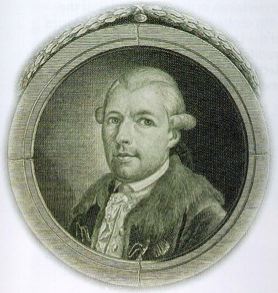
  • The founder of the Illuminati in 1776 later became a Freemason, so Freemasonry is just a political power structure aimed at creating a New World Order.
  • The irregular Grand Lodge, Grand Orient de France, became very political and organizationally if not ideologically anti-Catholic during the 19th century, resulting in its no longer being recognized as Masonic, so Freemasonry is just anti-Catholicism.

As you can see, the general theme here is that something happened that was or related to something else, so Freemasonry is just that something else. It doesn't matter that over 300 years you can find an example of everything you want for your conspiracy theories. It's still the very heart and soul of Freemasonry for purposes of these conspiracy theories.

Unfortunately for the conspiracy theorist, it actually is necessary, when using logic, to provide more than a correlation in the premise and also to maintain scope when asserting such equivalencies.

There are several related logical fallacies, here:


Claim: Freemasonry is an oppressor.

This one confuses me, but it keeps coming up. Mostly, it comes from Catholics and Eastern Orthodox, it seems, who think that separation of church and state, a common element of many Enlightenment-era philosophical takes on political structures, is inherently an idea put forward in order to justify oppression of their religious institutions, and that it's inherently Masonic.

The problem is that separation of church and state isn't an oppressive concept. Here in the US Baptists and Mormons and Catholics and Eastern Orthodox and Jews and Muslims get along reasonably well, and yet we have separation of Church and state encoded into our Constitution.

Regardless, this idea did not originate with Freemasonry. The modern idea of separation of church and state originated with Martin Luther and his Doctrine of Two Kingdoms. The idea was refined and further promoted by Enlightenment era philosophers such as John Locke who there is no evidence was a Freemason, though he obviously became a source of inspiration to the founding fathers of the US, many of whom were Freemasons. They even directly quote him in the Declaration of Independence.

But again, it's just not something that came from the Fraternity, and though many Masons might agree, many might not.

Claim: Freemasonry is Luciferian / Satanic

There are a few sources of this, all either misrepresentations or outright (and outrageous) hoaxes:

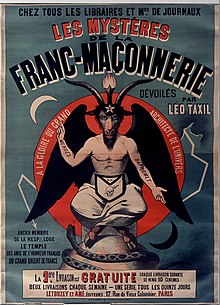
Poster related to
the Taxil Hoax
  • In the 19th century, Léo Taxil organized a rather intricate and long-running hoax where he claimed to reveal the "Luciferian secrets" of Freemasonry. He later revealed in a press conference that he was attempting to bait the Catholic Church with his gambit. The hoax, however, imprinted many aspects of the modern conspiracy theories relating to Freemasonry into the public consciousness, not the least of which was the image of the supposed idol of Masonic worship, Baphomet (see on right) which was a fictitious entity invented by the Inquisition during the torture of Knights Templar.
  • Albert Pike, a famous Freemason in the 19th century who was mentioned in the Taxil hoax, actually did write "Lucifer the Light bearer. Strange and mysterious name to give to the Spirit of Darkness. Lucifer the Son of the Morning. Is it he who bears the Light and with its splendors intolerable blinds feeble sensual or selfish souls? Doubt it not!" which is often misinterpreted as praise for Lucifer by anti-Masons. The actual meaning of the comment is in the penultimate sentence, however, "he who bears the Light and with its splendors intolerable blinds feeble sensual or selfish souls." In this, Pike is explaining the dangers of pursuing the Light of knowledge with impure purpose and warning that simply because Freemasons have rejected darkness, that doesn't mean that there aren't pitfalls awaiting the unwary. This theme that the pursuit of truth is a dangerous path when undertaken without caution and aid is repeated over and over in Pike's and many other Freemasons' work along with that of many other philosophers and sages. One need only look at the state of modern conspiracy theorist communities to validate this caution.
  • Manly Hall, another prominent Freemason, writes, "... he has learned the mystery of his Craft. The seething energies of Lucifer are in his hands and before he may step onward and upward, he must prove his ability to properly apply energy." Again, as with Pike, Hall is referring to Lucifer not with reverence, but as a caution. Hall is much more abstract and symbolic about it, but in essence he's restating the old adage: knowledge is power. The question is, what are you going to do with that power? Freemasonry teaches a system of morality, aimed at self-discipline and a love for all mankind as a way to help the student to apply his knowledge wisely, but there is always another (seemingly) easier path... that path is what Hall is cautioning the newly enlightened Mason of by using the metaphor of Lucifer, a powerful angel blinded by his own beauty and the pride it created.
  • In general, Freemasonry makes many references to Light, and "Fiat Lux," Latin for "Let there be Light!" is often seen in association with Masonic organizations. Many Christian anti-Masons attempt to link this use of the word "Light" with the name, "Lucifer," which literally means light bringer. It's a very flawed and tenuous connection, though, since the concept of light is mentioned hundreds of times in the Christian Bible, including the very phrase, "Let there be Light!" and in Jesus' own statements, making it difficult to assert that references to light would be exclusive to non-Christian or anti-Christian groups.
In any case, the critical feature is that Freemasonry doesn't worship, revere or seek any association with evil in any form. From Lucifer to Shaitan to Set to generic demons, jinn and hobgoblins... we are not a religion and most especially not a religion which worships evil.

Further reading: Pike & Lucifer (masonicinfo.com)

Relevant logical fallacies:

Claim: Masons don't learn the real secrets until the "upper levels"/33rd degree/etc.

An actual intelligence agency
patch from the United States
Government (NRO)
First, let's explore the general idea. The conspiracy theorist is positing a clandestine and elite group within Freemasonry that is so well disguised that 6 million Freemasons don't know it exists, and yet it somehow manages to continue to guide the Fraternity even given its decentralized nature (see the section on Grand Lodges, below). Let's take this as given, even though it's not actually true... what's a bit shocking is that these same conspiracy theorists are convinced that the secret, elite group is known to nearly every conspiracy theorist in possession of a YouTube account... There's a contradiction there. They not only claim that the existence of such a group is known to them (but not to "low level" Freemasons) but that they know the details of their highly secret and nefarious plans! The contradictions continue to deepen as you look into these claims. Freemasons, it seems, must have very long necks in order to be able to bury them so far in the sands of willful ignorance!

However, let me also clear up this "33rd degree" thing. Non-Freemasons think there are some fixed number of "degrees" in Freemasonry that are like ranks. This is false. Freemasonry has a profusion of degrees that might, functionally be impossible to count because many of them are specific to a jurisdiction.  It is common for these degrees to either be numbered 1-3 (the first three introductory degrees almost always carried out in what is called a "Blue Lodge" of which there are several regional and historical variations) or for them to be numbered starting after the number of the degree which they have as a prerequisite.

These are not "ranks" for many reasons, but first and foremost among those reasons is the fact that all Master Masons are seen as equals. It's also a practical matter: would a 4th degree York Rite Mason be senior to or junior to a Scottish Rite 4th degree? As it turns out, there's no comparison made. In the Scottish Rite your progress in the York Rite degrees doesn't have any relevance. They're separate institutions within the body of Freemasonry.

So, whenever you hear someone talk about "higher levels" of Freemasonry, ask them exactly what they mean, and in what part of the organization. It's likely that they're simply demonstrating their ignorance of the basic structure of the Fraternity, and anyone who claims to know the best-hidden secrets of an organization that they don't even understand the structure of... is probably safe to ignore.

Further reading: The complex system of degrees as organized in Canadian Freemasonry (freemasonry.bcy.ca) and in the United States (themasonictrowel.com)

Claim: Freemasons are required to help their Brothers regardless of what crimes they commit or lies they tell.

This one is easily discarded. Freemasons are expelled from the Fraternity for failing to live up to the ideals set forth by the three degrees, one of which is a cheerful compliance with the laws of one's country. If you discard that obligation and commit a crime, then we're not obliged to help you to commit or get away with it, as that would be a violation of our own obligation.

There is a counterexample often used by conspiracy buffs from a 19th century showman and "exposer" of Freemasonry. He essentially just made up Masonic initiations on his own and "exposed" them. They were often based on the real initiation ceremonies with exciting new additions like promising to hide any crime one's Brothers committed, but these were fabrications made for audiences, not real Masonic initiations, the text of which had actually been published by that point and anyone who wanted to confirm that this huckster was lying could go visit the library and do so.

Claim: Judges give a pass to Freemasons who come before them.

Judges have a number of loyalties that they must set aside in order to serve their nation's judiciary. They must set aside their personal concerns, those of their culture and, in most nations, those of their religion. They must faithfully adjudicate the law and only the law. Do all judges live up to this lofty standard? Of course not, but I think Freemason judges are more equipped to deal with such ethical quandaries than most, and so I would certainly not expect to receive any different treatment from a Brother judge than any other. I would expect to be given the benefit of reasonable doubt and otherwise disposed of fairly.

I think that the assumption that Freemason judges aren't impartial toward Freemason defendants is an unfair accusation against all judges and their integrity. That said, I think that it would be common practice and a requirement of most civilized nations that a Judge who had direct ties to a Brother (e.g. someone from his Lodge) should recuse himself from any case involving him.

Claim: Freemasons control the [insert name here] industry.

There are some Freemasons who are successful businesspeople. However, claims that any organization controls any industry have to be backed up with more than just a demonstration that one or more successful members of that industry are members of that group.

And in every industry that I can think of, Freemasons certainly do exist, but they exist at every level, and aren't exclusively in charge of any subset of that industry.

Claim: Freemasons are part of a Jewish conspiracy.

WWII German anti-Freemasonry
poster claiming Jewish political
control of the Fraternity.
It's easy to see how this idea evolved. Freemasonry was founded in regions where it was a safe assumption that most people were some form of Christian with a few Jews and even fewer Muslims. Atheists, Buddhists, Hindus, and various other faiths and non-faiths just weren't very widely represented, and so Freemasonry's symbols and allegory are built on the common elements of those three religious traditions. Those common elements are what Christians call the Old Testament.

Particularly, the story of the Temple of Solomon figures strongly in the allegory of the degrees of Freemasonry as a metaphor for the spiritual temple that a man constructs throughout his life, regardless of what faith he might subscribe to.

The Germans, during WWII, for example, took this to be sufficient evidence to herd tens of thousands (some estimates suggest over 100,000) Freemasons (both regular and irregular; as the enemies of Freemasonry don't particularly care about that distinction) into concentration camps and eventually murder them, but it's simply untrue that there's some sort of Jewish agenda in Freemasonry. Freemasonry is independent of and a complement to every religion. It is a set of moral, philosophical and social lessons which do not promote or conflict with any religious world view.

To quote Angel Millar, author of "The Crescent and the Compass,"

Belief that the Freemasons [secretly] control the world goes back through a line of conspiracy theories, all of which have been debunked, though it owes its popularity to The Protocols of the Elders of Zion, an anti-Semitic fake ... the current fixation with “the Illuminati” emerged after the “Satanic Panic” of the 1980s, when claims, by various Christian groups, that there was a global criminal network of Satanists was discredited.


And on that note...

Claim: Freemasonry is anti-[insert religion here]

The only religions that Freemasonry would be opposed to would be those founded on hate and intolerance.  In practice, almost every religion has the potential to fall into these traps when practiced by those unwilling to let go of those qualities in themselves, but are not defined by them.

Many religions view Freemasonry with suspicion because we do not explicitly promote their dogma. This is true, but we also don't refute it or require (or even suggest) that our members do. Faith in any particular religion is a choice made by an individual (except in the presence of extreme fanaticism) and Freemasons do not tell other Freemasons how to make that choice. If a Freemason wants to preach their religion to a Brother, they are free to do so outside of the Lodge, but inside the Lodge or at official functions, there is no mention of sectarian religion because it's divisive. This isn't anti-religious.

Claim: Freemasonry is a religion.

There are many definitions of religion, but the most basic is a system of belief, acted on through ritual or observance, usually focusing on supernatural worship. Freemasonry does not have a system of belief. We have a system of morality that is predicated on the individual Brother's system of belief. That's absolutely key in understanding the difference. If you believe in the divinity of Jesus then no one in Freemasonry will ever tell you that you must discard or modify that belief. Instead, the moral principles of Freemasonry will fit into that belief. The same is true for members of any religion.

Claim: Freemasons Worship The Great Architect, which is a false/deistic God.

Masonic allegory refers to
but does not define the
Great Architect of the
Universe
The "Great (or Grand) Architect of the Universe," is a metaphorical phrase used by Freemasons, however, it does not refer to any specific deity. Instead, it refers to a common element of many faiths, and the core and only requirement of the Fraternity with respect to religion: you must believe in a Supreme Being. To a Jewish Freemason The Great Architect refers to the G-d of the Torah. To the Trinitarian Christian Freemason The Great Architect refers to the Holy Trinity. To the Hindu Freemason The Great Architect refers to Brahman.

Each Mason has their own beliefs and cultural context, but there is no "Masonic deity."

This claim also ties into many related claims such as Freemasonry being a deist organization or a syncretic organization. Both are subtly untrue. While some Freemasons (including this author) are deists, we are in the minority and our views are not that of any official body. We just have a belief system that happens to be among the many that are held by individual Freemasons.

As for syncretism, that's a subtler issue. The difference between, "you must be willing to sit in Lodge with and respectfully discuss elements of religious ideas with those of other faiths," and the syncretic idea that "all faiths are fundamentally equivalent and compatible," can be difficult for some people to see, but it's a very important line. The majority of Freemasons would not be comfortable at all with the latter statement, but are clearly willing to abide by the first.

See also, the "Freemasons aren't or cannot be Christians" section, below.

Claim: The First Freemason to reveal the secrets of the Fraternity was murdered.

William Morgan,
an anti-Masonic author who
was kidnapped and possibly
killed.
This is a reference to the William Morgan Affair. Morgan was a Freemason in New York State who decided to publish an expose on the inner workings of the Fraternity. After doing so, he was treated very poorly by his fellow Masons and eventually was whisked away from the jail where he was being held for an unpaid debt and allegedly either killed or forced to leave the country.

That said, here are some interesting facts that are often left out:
  1. Morgan was far from the first to publish such details. The first was over a century prior in the 18th century, and there had been many in between. The only reason we remember Morgan so acutely was the fact that he was treated so badly and possibly killed after doing so, not because he was the first. From this, we can reason that this was a highly unusual case and that the Masons who attacked Morgan were not behaving like the majority of Masons would and did act in similar cases.
  2. Morgan's assailants were denounced and their actions rejected as non-Masonic. While the Fraternity must take responsibility for having welcomed these wrongdoers into its midst, it is also not reasonable to paint the entire Fraternity of millions of men over hundreds of years with the brush of the actions of a handful of men in one incident.
  3. The Morgan affair happened nearly 200 years ago. It's very telling that in order to find such an egregious case of Masonic wrongdoing, we can't even rely on the past century, but must dip into the early days of US history to find an event universally decried by the vast majority of Masons.
  4. There are reports that Morgan was simply paid $500 and told to go back to his native Canada and never return. While I find this only mildly plausible and it doesn't excuse the other behavior, I refuse to convict anyone without evidence that is beyond the shadow of a doubt.
The last point that I should bring up is that the Morgan affair is most acutely remembered not because of the crime itself, but because it was the event which the Anti-Masonic Party (a national US political party) used to launch itself into the public eye and fuel outrage against any candidate not willing to renounce the Fraternity regardless of how vehemently they renounced the Morgan Affair itself. This kind of political witch hunt is unsavory at best, and certainly is not a useful basis for civilized discourse.

Update: Note that sometimes this story gets confused with the death of Joseph Smith, the founder of Mormonism. Joseph Smith is said to have given some Masonic signs of recognition on his death, but those stories are entirely unsubstantiated. Whether he did or did not, however, it's important not to conflate that with Morgan. Smith was killed by a mob that was reacting to the destruction of a local newspaper and his declaration of martial law in the town, not over some Masonic dispute.

Further reading: The history of exposés of Masonic ritual (freemasonry.bcy.ca)

Claim: Freemasonry is made of up of the elite.

This is mostly untrue. It is true that some Freemasons are rich. It's true that some Freemasons are powerful people in their own rights. But it's also true that such people are a dramatic minority, as they are in every other walk of life, who rarely have the time in their busy lives to do a great deal with the Fraternity.

What's more, the Fraternity is made up of millions of men from every walk of life, socio-economic status, political affiliation and so on, so if you want to talk about some elite cabal of control then you'd be headed back to the above "Masons don't find out the evil/world-controlling secrets..." myth.

Now, let's head on to some true, but perhaps misleading items:

Claim: Freemasonry isn't and Masons can't be Christian.
George Washington Truett,
Baptist and Freemason
The first half of this is true in that the Fraternity is not a Christian organization and Freemasons can be from any religion that meets our basic "Supreme Being" and moral criteria. However, this is often said with the implication that Freemasonry doesn't fall in line with Christian ethics or that you cannot be both a Christian and a Freemason. This is, of course, absurd, and is easily discounted by looking back at the long list of exemplary Christians who have been Freemasons.

As stated previously, Freemasonry is not a religion and does not seek to restrict or modify its members religious beliefs. It is a system of moral philosophy that can be employed in the lives of any good man, regardless of their faith, ethnicity, culture, age, etc.

There are many examples of men from all of the major denominations of Christianity who were Freemasons. Even Catholicism which officially rejects the Fraternity has had devout and active men join its ranks, including at least one young Bishop who would one day be Pope and for whom reasonably conclusive documentation is available (Pius IX Pope from 1846-1878, initiated 1839, expelled 1874).

Update: One spin on this claim that you might hear is that Masonic initiation is equivalent to the Christian concept of being "born again" and thus is heretical. This is ... at best, silly. Masonic initiation is a rite of passage like any of the thousands of others in our culture. As such, it can be compared to every other rite of passage, and that includes being born again. But I would not suggest that someone cannot be both Christian and have Sweet Sixteen party or a college graduation ceremony. Taking part in rites of passage does not make one less Christian, even when they also contain religious allegory.

Further reading: Conscience and the Craft, Ill. Dr. James Tresner. (mit.edu)

Claim: You have to be a Christian or you can't advance in the Fraternity.

Symbol of the
Masonic Knights Templar
This is highly misleading, but is based on a kernel of truth: there are two organizations you can't join if you're not a Christian: the Swedish Rite, which is Sweden's local, generic form of Freemasonry, but Christian-themed; and the Knights Templar, a group within the York Rite (mostly in US Masonry) that only allows Christians by default, though exceptions are made in some areas if you are willing to take a Christian-themed oath.

Neither of these two are in any way necessary for advancement in the Fraternity (you can be Grand Master of Masons in your jurisdiction without being either.) The former is just a local oddity and the latter is a kind of a special-interest group for Christians in the Fraternity.

In general, the Fraternity stresses universality. That is, its principles must apply equally to all of its members. We cannot be a purely Christian organization because not all of our Brothers are Christians and it is as important that the Fraternity be relevant to them as it is for any member.

Further reading: The Grand Lodge of Massachusetts' decision to allow Buddhist and Confucianist applicants (masonicdictionary.com; note: the stilted, archaic language here might seem very off-putting... we don't use words like "Chinaman" any more, but they were not considered prejudicial in 1915)

Claim: Freemasons use a symbol that's associated with evil.

Grand Chapter of Massachusetts,
Order of the Eastern Star
via oestar.org
This is quite true. Many symbols of the Fraternity have come to be associated with evil at one point or another. For example, the five-pointed star, which appears in many older Masonic contexts and in the primary symbol of the Masonic-related Order of the Eastern Star, is many times associated in modern contexts with the occult and/or evil. However, these symbols trace their lineage back much further and have individual interpretations in every major religion, philosophy and initiatic tradition. That is why, for example, the five-pointed star was chosen in the late 19th century, well after the founding of the Fraternity and the Order, by an occult group to be a major symbol of their work and was, from there, chosen by Anton LaVey for his Satanic Bible.

But just as the Hindus were using the swastika (or svasti sign) since the Iron Age, which wasn't associated with evil until the mid-20th century when Germany's National Socialist Party took up its use, the various symbols of the Fraternity have, in some cases, been re-appropriated by nefarious groups as symbols of their own. This doesn't make their use historically or even in the modern day "evil." I think it's unreasonable to try to assert that a group somehow loses the privilege of using their own symbols as soon as some other group misuses them.

Freemasonry has used and continues to use many symbols which seem obscure or even frightening to those not aware of their historical significance and allegorical meanings, but they are in no way used to represent evil or wrongdoing within the Fraternity.

Claim: Many of the Presidents of the US were/are Freemasons and the Masonic All Seeing Eye appears in the Great Seal of the US

While these are both at least partly true, they're used to insinuate that there's some sort of Masonic control over the government in the US. This is not borne out from these details, as you will soon see...

The answer to this one is in three parts:

First, the Fraternity does not control the US government. There are Freemasons in politics, certainly, but I think the influence tends to go in the other direction, in such cases. Powerful people with powerful personalities tend to have a profound impact on the organizations that they join, and Freemasonry is no different. The Federal Government of the US, on the other hand, is a massive bureaucracy that it would be hard for any small group of people (even the million+ US Freemasons) to have more than a passing influence on.

Second, there have been 14 US Presidents who were Freemasons, which is not even close to half of them. There are also some outliers who we don't usually count, but if you want to go up to 16, you can include LBJ (initiated into the first degree, but never had time to follow up) and Bill Clinton who is not a Mason, but was in the Masonic youth organization, DeMolay. There have been claims of every President, except for the one or two overtly anti-Masonic ones, being Freemasons, but this is just fantasy, unsupported by even the most casual documentation. Usually, these assertions are based on association with a college frat that isn't Masonic (Freemasonry exists on many college campuses, and does not need crypto-Masonic stand-ins) or on some clumsy handshake (I've seen every kind of odd grip "exposed" as a Masonic handshake on conspiracy sites but none of them are terribly convincing evidence).

Further reading: United States Presidents (mastermason.com)

The All-Seeing Eye or Eye of Providence

Third, the use of common symbols in US seals and symbolism within Freemasonry is not a clear indication of a direct connection and the All Seeing Eye or Eye of Providence is an excellent example of this. The Eye was a common symbol, prior to the 19th century, of the divine protection and guidance that the Declaration of Independence claims that people exercising self-rule are afforded. As such, it was a very common symbol in secular and religious contexts at the time. For context, it is useful to compare to the peace symbol in use today. That symbol came to represent many different movements from the counter-cultural hippies to the anti-Vietnam War movement to the nuclear disarmament movement and so on. But any group that uses that symbol is not revealing a system of hidden influence; they are simply taking advantage of a common cultural symbol which people will recognize.
Further reading: Eye in the Pyramid (msana.com)

Claim: Freemasons are Illuminati

Adam Weishaupt, the
founder of the Illuminati
As mentioned above, the Illuminati were a briefly lived organization of men, some of whom were also Freemasons. This was not accidental. Adam Weishaupt joined the Freemasons one year after founding the Illuminati and used his membership in the Fraternity to attempt to recruit new members. Their ideas were certainly radical for the time: the people should run the government democratically; oppression is never right, even when there is a claimed divine mandate; etc. However, such a group formed today would be considered uninteresting except for the fact that he felt such developments must be forced on those who do not desire them. That said, the connection between the Fraternity and the Illuminati was tenuous at best, and when the Illuminati failed, that connection ended. Any other claim has nothing to do with Freemasonry.

However the phrase as used today most often refers to any powerful group with its own, hidden agenda, and not specifically to the Bavarian Illuminati of 1776. In that light, the Fraternity isn't really correctly identified by this term either. Freemasonry has, at its heart, one goal and that goal is clearly and publicly articulated: to aid the good men who come to its doors to make of themselves better men through a system of morality and philosophy.

The Meta-Claims

Looking back over this list of claims, one new claim might emerge: Freemasonry seems to attract an awful lot of negative attention. There must be something there, reasons the anti-Mason, which generates such claims. There must be some evil afoot which causes Freemasonry to elicit such fears!

Further reading: The burden of proof

It's true that there are many claims, here, and that Freemasonry has evoked much fear from some quarters, but it is relatively easy to dismiss this fear by simply asking: what good and what ill has the Fraternity done? Obviously, Freemasonry was a central theme among many of those good men who helped to found the United States of America and was a driving force in the establishment of individual liberty as a necessary human right. These are unquestionably (in my view) good things. However, there have been darker aspects. The Morgan Affair, mentioned above, is one of our darkest moments.

But we must remember that one cannot simply point out that good men sometimes do bad things or that bad men sometimes join good organizations. One must actually demonstrate, in order to validate the anti-Masons' claims, that Freemasonry is endemically tainted by these ills. This is a claim which I see no validation for within the Fraternity or without.

The other meta-claim is that none of the dire claims of the anti-Masons may be exactly true, but that that is not a valid defense of the Fraternity. This is most assuredly true, and a positive defense of the Fraternity is a project that I intend to take up in the future. I think many Freemasons have taken this on in the past, though, so if you want to look into that, I suggest the following sources:

On a side topic:

The Grand Orient de France, Continental Freemasonry and Irregular Lodges

You will often hear the claim that "Freemasonry thinks..." some particular thing or "Freemasons are trying to..." do whatever nefarious thing some anti-Mason wants to ascribe to us. The fact is that we're just not that monolithic. In fact, we're so non-monolithic that we're a model of semi-autonomous, democratic processes. So, first let me cover the structure of the Fraternity and then move on to some specifics that you'll often hear about from anti-Masons.


Grand Lodges
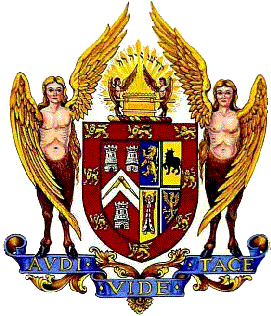
Coat of arms of the
United Grand Lodge
of England
In 1717, several Masonic Lodges which had been operating independently formed the United Grand Lodge of England. That Grand Lodge still exists today and is the central governing body of Freemasonry in England, Wales and the Channel Islands.
Further Reading: United Grand Lodge of England
The UGLE is still a very prominent body in modern Freemasonry, but that's all it is. It's not the seat of government of Freemasonry. So where is that? Well, it turns out there's no such thing. Instead, every Grand Lodge is autonomous. My Grand Lodge, The Grand Lodge of Masons in Massachusetts, was the third Grand Lodge in the world and the first in the American Colonies. In the US, because of the colonial history, we have a Grand Lodge for every state and Washington D.C. But in most parts of the world, Grand Lodges are organized on the level of nation.

Each Grand Lodge's member Lodges elect a suite of officers including a Grand Master (who usually serves for 1-3 years depending on the jurisdiction) and they run the show.

Ah, but what if they decide that Freemasonry isn't really a philosophical and moral Fraternity, but a sports betting club or a knitting circle? That's where recognition comes in. Every Grand Lodge recognizes the "regularity" of every other Grand Lodge as long as they continue to keep to the traditions and history of the organization. If they don't then some or all Grand Lodges will stop recognizing them. This can mean many things, but most importantly, it will mean that their members can't travel to Lodges in other jurisdictions, join those Lodges if they move, or take part in any event that happens outside of their jurisdiction. In practice, this is almost always sufficient to keep Freemasonry on an even keel and prevents any kind of central bureaucracy from forming.

There is one problem, however, and it's a problem that can never really be fixed: Anyone can call themselves a Freemason. More importantly, a Lodge or Grand Lodge that is or becomes "irregular" (i.e. stops being recognized by other Lodges or Grand Lodges) can't be stopped from continuing to attract members and claim to be Masonic.

Such is the case in France where the Grand Orient de France broke away from the rest of the Fraternity in the 19th century. They began being much more political (backing individual candidates and agendas in open Lodges and as a matter of policy; something Freemasons cannot do elsewhere) and they began admitting atheists and women as members. After over 100 years of not being recognized, however, they still exist and they have grown distinctly anti-Catholic (in terms of politics and institutional opposition, though many Catholics are Grand Orient members). This reflects very poorly on Freemasonry, but we have no power to  change the situation other than by recognizing another French Masonic Grand Lodge such as the Grande Loge Nationale Française (GLNF) which, in fact, is currently becoming the case.

Meanwhile many anti-Masonic claims stem from the actions of the Grand Orient de France. It's difficult to explain how these claims do not apply to the Fraternity as a whole when, as described above, there is no Fraternity as a whole. The most that can be said is that the Grand Orient de France's activities and views are not supported by or endorsed by the majority of Freemasonry.

Even more confusingly, there are a network of Masonic and Masonic-like bodies that recognize and, in some cases, are recognized by the Grand Orient de France. These are collectively referred to as "Continental Freemasonry," and as the name implies, are mostly located in continental Europe. Such organizations include Co-Masonry, Le Droit Humain and other, smaller groups. If you hear these names, just be aware that they're not what I would call "mainstream Freemasonry."

Additional sources and references

The Google shortened URL for this post: goo.gl/0pI3bA