I'm often confronted with variations on the assertion that Freemasonry is a business networking opportunity. Let me be clear: it's not. But there's a related question to which the answer is more complex, and I think Freemasons don't promote this question enough: is Freemasonry good for your career?
To this, I give an unequivocal "yes". In fact, it's a great career move for many reasons, some of which I won't get into, here, such as the role of self-knowledge in professional life. They're all useful topics, but for now I'll just stick to the simple question of why you might get hired for a job because you're a Freemason.
Now, if you're thinking, "the hiring manager might be a Freemason, and so they'll hire me," then stop right there. Not true. First off, the hiring manager almost certainly isn't a Freemason. Since the 1960s, membership in Freemasonry has declined substantially, and there's no reasonable case to be made that one should expect to run into a fellow Mason at work. There are probably on the order of 100 Freemasons in my city whose work plus residential population is probably around a half a million. That's 1 in every 5,000 people you might run into that are going to be Masons. Good luck with that.
So why, then?
Because the Masonic Lodge is one of the most profoundly impressive leadership training systems in the world, even though far too few people within the Fraternity seem to realize this, or at least the avoid talking about it.
Think about it: you spend somewhere around 7 years (depending on jurisdiction) learning every facet of running the Lodge, from setting up the tables and regalia to organizing the caterers and candidates. Then you spend a year or so actually being the executive management in charge of the Lodge. You have to learn how to work with a Secretary and Treasurer to actually run the business of the Lodge. You have to learn how to manage volunteer labor. You need to learn what works and what doesn't when it comes to getting work out of people.
These are not just relevant skills, they're the kinds of skills that the majority of people will never learn! I know of less comprehensive programs that are entirely based on simulation and classroom work that cost a fortune! But Freemasonry tends to cost less than going to see a movie once a month and gives you a fully rounded experience. Is it draining and demanding? Of course it is, but it will be when you do these things in your professional life, and learning to balance professional and personal demands is yet another part of the lesson.
So that brings us to how you sell yourself on this basis. How do you tell an employer? Well, here's what I wrote up recently to answer that very question:
Showing posts with label fraternity. Show all posts
Showing posts with label fraternity. Show all posts
Monday, September 18, 2017

Sunday, March 27, 2016
The position of the Grand Lodge of Franklin with respect to recent developments in Georgia and Tennessee
Sunday, March 27, 6016 AL
Worthy Brethren,
Since its founding in 5784 AL (1784 by AD reckoning), the great State of Franklin has been seen world-wide as a symbol of the universal love and harmony espoused by our namesake, M.W. Benjamin Franklin. But in recent days, that harmony has been sorely tried within the distinguished halls of Freemasonry. A rift has appeared in our ranks over the interpretation of scripture and its relevance to our Craft. Specifically, the VSL which is a Great Light of Masonry here in Franklin admonishes a man not to "lie with mankind, as he lieth with a woman," so there can be no doubt that such an act is in contradiction of the moral principles of our Craft... or can it?
We cannot fail to acknowledge that not all Christian orders within our sovereign jurisdictional borders concur with this assessment of the Holy Bible and more relevant, the Grand Lodge of Franklin has many a worthy Brother who are not Christian. Even within other Abrahamic religions, conservative Judaism, for example, has ordained homosexual rabbis and obviously this Grand Lodge is in no position to question their practice of their own faith.
Rather, this Grand Lodge takes the position that these are matters of sectarian religion and of profane politics. The purpose of a Grand Lodge is to oversee the regularity of the work of its Lodges and to represent their interests in the larger community of Freemasonry. That role does not require us to peer into men's bedrooms or to adjudicate their creed. Indeed to do so would rightly be deemed un-Masonic as it tears down one of the most fundamental of Landmarks: the universality of Freemasonry; that we do not accept or reject the political or religious views of the Brother we sit next to in open Lodge, but rather love him for the Brother he is, regardless of whether we agree or disagree in the profane world.
But our good neighbors in Tennessee and their neighbors in Georgia have taken such a position. As such a call has been made from some quarters for us to suspend recognition of these two Grand Lodges. We will not take such an action. To do so every time we believe a Grand Lodge has strayed from the Landmarks would result in a state of uncertainty on the part of all Franklin Masons. Rather, we will selectively fail to recognize the suspension or expulsion of any Georgia or Tennessee Mason for the sole reason of their sexual orientation or marital status. Any such Brother, being deemed worthy in the eyes of the Grand Lodge of Franklin by a committee to be appointed, shall be given honorary status as a Brother in this Grand Jurisdiction, should the Brother so desire.
This leaves the choice of recognition entirely in the hands of those two Grand bodies. Should they desire, they can suspend recognition of Franklin over what I am certain they will see as a violation of our jurisdictional rights. This is their choice, and we will not question their right to take such action, should they deem it necessary.
However, let us always remember that Freemasonry is about more than our inter-Grand Lodge politics. Freemasonry aims to make good men better, and as such we will now return to our Craft with the hope that we can proceed with that more sublime task and leave this issue in the background where it belongs.
Fraternally,
Washington C. R. Frater,
Grand Master
Most Allegorical Grand Lodge of Franklin
Worthy Brethren,
Since its founding in 5784 AL (1784 by AD reckoning), the great State of Franklin has been seen world-wide as a symbol of the universal love and harmony espoused by our namesake, M.W. Benjamin Franklin. But in recent days, that harmony has been sorely tried within the distinguished halls of Freemasonry. A rift has appeared in our ranks over the interpretation of scripture and its relevance to our Craft. Specifically, the VSL which is a Great Light of Masonry here in Franklin admonishes a man not to "lie with mankind, as he lieth with a woman," so there can be no doubt that such an act is in contradiction of the moral principles of our Craft... or can it?
We cannot fail to acknowledge that not all Christian orders within our sovereign jurisdictional borders concur with this assessment of the Holy Bible and more relevant, the Grand Lodge of Franklin has many a worthy Brother who are not Christian. Even within other Abrahamic religions, conservative Judaism, for example, has ordained homosexual rabbis and obviously this Grand Lodge is in no position to question their practice of their own faith.
Rather, this Grand Lodge takes the position that these are matters of sectarian religion and of profane politics. The purpose of a Grand Lodge is to oversee the regularity of the work of its Lodges and to represent their interests in the larger community of Freemasonry. That role does not require us to peer into men's bedrooms or to adjudicate their creed. Indeed to do so would rightly be deemed un-Masonic as it tears down one of the most fundamental of Landmarks: the universality of Freemasonry; that we do not accept or reject the political or religious views of the Brother we sit next to in open Lodge, but rather love him for the Brother he is, regardless of whether we agree or disagree in the profane world.
But our good neighbors in Tennessee and their neighbors in Georgia have taken such a position. As such a call has been made from some quarters for us to suspend recognition of these two Grand Lodges. We will not take such an action. To do so every time we believe a Grand Lodge has strayed from the Landmarks would result in a state of uncertainty on the part of all Franklin Masons. Rather, we will selectively fail to recognize the suspension or expulsion of any Georgia or Tennessee Mason for the sole reason of their sexual orientation or marital status. Any such Brother, being deemed worthy in the eyes of the Grand Lodge of Franklin by a committee to be appointed, shall be given honorary status as a Brother in this Grand Jurisdiction, should the Brother so desire.
This leaves the choice of recognition entirely in the hands of those two Grand bodies. Should they desire, they can suspend recognition of Franklin over what I am certain they will see as a violation of our jurisdictional rights. This is their choice, and we will not question their right to take such action, should they deem it necessary.
However, let us always remember that Freemasonry is about more than our inter-Grand Lodge politics. Freemasonry aims to make good men better, and as such we will now return to our Craft with the hope that we can proceed with that more sublime task and leave this issue in the background where it belongs.
Fraternally,
Washington C. R. Frater,
Grand Master
Most Allegorical Grand Lodge of Franklin
Friday, January 22, 2016
What is initiation, why is it secret and how does society benefit from it?
 |
| The Initiation Chamber Villa of the Mysteries, Pompeii |
So, what is initiation? In its simplest form, it is the recognition of entry into a new role or subculture in a larger society, using a system of ritual, performed exclusively by those who have previously been initiated.
Let's look at some examples to clarify what that means: When a man is going to be married, most Western cultures have some sort of ceremonial celebration at which the man is prepared for his new role in society as a husband. In the US we usually call these "bachelor parties." Similarly, when one joins the military, there are many distinct rituals of bonding and acceptance performed as a part of "basic training."
Within the societies which perform stand-alone initiations such as Freemasonry, Rotary and so on, the role of the initiation is not merely a demarcation which one experiences and then moves on. It is an entry into a fellowship, but the process is still very much the same.
We now have a sense (if only by example) of what initiation is, so why is it almost always secret?
Certainly, there are elements of many initiations that are considered private matters (bachelor parties might involve watching a "stag film" or, more commonly in the modern day, hiring an exotic dancer; military initiations might be considered violent by outsiders; etc.) but this is not the primary reason for secrecy.
Rather, secrecy is a part of the reason for initiation. Forming a hidden "token" of belonging between the initiate and the existing members of the group makes the act of initiation meaningful. We see this in every trivial act of initiation from the proverbial "keys to the executive washroom" to the programming communities where contributors who have been accepted into project are given permission to submit new source code.
This gives us a reference point from which to begin to talk about how initiation benefits the individual, the group and society at large.
For the individual, initiation is a signpost. Before and after initiation one leads different lives: the exoteric and the esoteric. By creating and valuing an esoteric context, we promote the notion that there is meaning and value in belonging and contributing to something which is more than just the sum of its individual members. This idea, in turn, is the hallmark of functioning societies.
To quote Yeats' poem, The Second Coming, "The best lack all conviction, while the worst are full of passionate intensity." It is this lack of conviction on the part of those who have the most to contribute which initiation is meant to address and resolve; not simply by bonding the initiate to the existing members, but by bonding them to the initiatic body itself and teaching them that they can add value to their cultural context by seeking the acceptance of their peers.
In a future update, I will address specific historical examples of societies with and without strong initiatic traditions....
Monday, January 11, 2016
Is This Your Work? The Journey of a middle-aged, young Mason
In 2012, I was part of a local gaming group. We played a variety of games including some of the euro-import board games and various roleplaying titles, usually focused on rich story and political intrigue. One of our gamers was a really interesting character. He was a former rabble-rouser and very politically aware and active liberal guy who also happened to be gay. All of this may seem irrelevant, but it formed a picture in my mind of who he was and how I expected his life to be.
Then that all changed. One day, he told me he was a Freemason. "Wait... what... you?!" I must have asked with some obvious incredulousness. Yes, he was one of those old guys that sat around talking about Elizabethan politics over brandy and a cigar... or at least that's what I thought Freemasons were when they weren't out driving their clown cars.
This drove me to learn more. I started studying Freemasonry a bit and asked casual, low-key questions every now and then, trying not to step on any need for secrecy that would prevent his answering further questions.
This was at a time in my life when much had changed. I'd come out as bisexual to my friends and family over a decade before, but the process is never quick or simple. One of the more unexpected and tangential results of that transition was a change in my beliefs. I'd always called myself an agnostic. I didn't deny the existence of God, but neither did I think that there was likely an old man in the clouds waiting for me to pray to him. I had no particular faith, but more and more, as I questioned my role in society, I also questioned my role with respect to existence.
That all came to a head as I investigated Freemasonry. I started reading about men like Ben Franklin who identified as deists, and I looked into their beliefs. The classical deists were more or less Abrahamic theists without the dogma and generally held to a non-interventionist view (e.g. no miracles).
I thought: if this Franklin fellow could be a Freemason and hold more or less the same view that I do, why can't I?
So, I approached my friend and asked about joining the Fraternity and how one went about doing so? Did he have to ask me or could I just fill out an application?
I was invited to the Lodge and given a tour. My silly questions were answered and maybe I asked one that wasn't... I don't remember, but I know I asked about why women weren't in the Fraternity and why there were secrets and whether anything I'd be asked to do or take an oath to would violate my conscience... all of the usual stuff.
He reassured me on every point that this wasn't the kind of group that someone like himself would have any problem with, and so I was unlikely to be concerned, but that Freemasonry isn't a prison, and I was free to turn around at any time.
With this assurance, I took my first step. I came back for an interview and the application process a little while later and then panicked over whether or not they were going to reject me... it took so long (probably a month or two, but I was really wound up about it at the time).
In the end, my journey as a Mason began the way all of the worthy Brothers before me have begun: with that first step forward to the door of the Lodge room.
After my initiation, my mind was swirling! There was so much there! There was morality and philosophy and history and a kind of art that I had never experienced before! Like every earnest Mason after that first degree, I was overwhelmed and, of course, I'm still unravelling that experience today.
What struck me most in joining the Fraternity was not just the eagerness to have another set of hands... I expected that, but the eagerness to teach, to discuss, to puzzle out the nature of our work. This is now my work, and it will be judged by future generations, I suppose. Is it good work?
Wednesday, October 14, 2015
Honest Trailer: Freemasonry
 |
| Symbols often obscure the discussion of Freemasonry with non-Freemasons. |
So let's begin at the beginning. Most attempts to summarize the benefits of Freemasonry fail to be coherent or are overly simplistic. Typically they are in the form of vague language such as "Freemasonry is a system of morality," or, "Freemasonry teaches a set of moral lessons using an abstract and symbolic language." To the uninitiated, this sounds not only strange, but arguably like the doublespeak of a cult, and I think tends to alienate more prospective members than it attracts. Instead, I'm going to try to break down what kind of people would be interested in Freemasonry, what kind of people would not and what the former would get from it in simple language without using vague terms like "system" or arm-waving at what we do by calling it "lessons."
First, some basics so that we're all on the same page: Freemasonry is a fraternity. You've probably heard this, but it's probably a less useful term than we might hope. The term has come, primarily, to refer to the Greek system of fraternities on college campuses. These organizations are, to some extent, modeled on Freemasonry but they are not Masonic bodies and their goals can vary widely. Instead, Freemasonry is a fraternity in the sense that it is a social organization of men with a common set of interests.
Freemasonry is also an initiatory body. That is, we have an initiation ceremony that must be undergone before one can become a member of the organization. This initiation is broken up into three parts: the Entered Apprentice degree, the Fellowcraft degree and the Master Mason degree.
Each degree teaches a set of philosophical ideas that are deeply entwined with the notions of deity, charity and self-discipline.
To return to the goal of this posting, now that we've established the basics, let's get to the questions:
Question: Who would be interested in Freemasonry?
Any man with a belief in a Supreme Being who has a desire to answer larger questions in his life than those of his own benefit. More specifically, Freemasonry provides a man with a massive and highly concentrated set of teachings through these degrees and Freemasons have literally spent their lives unraveling those degrees and determining what they mean to them. Men who find that philosophy is fascinating but daunting because of its extreme breadth and thousands of years of history will often find that Freemasonry gives them a way to "find their depth" and learn at their own pace. One can comprehend the degrees merely as initiation formalities and otherwise enjoy the company of their new Brothers or one can dive deeply into the symbolism and tradition of those degrees in order to become a true scholar of the Fraternity. Both types of men are welcome in our Fraternity.
Question: Who would not be interested in Freemasonry?
If you read the above paragraph and concluded that this sounds like a bunch of intellectual self-satisfaction, then you're probably not going to get much from the Fraternity. You could still join and could still derive enjoyment from being a member, but it would be a bit like going for a "swim" in the ocean and never doing more than getting your toes wet.
Also, those who are either atheists or are offended by abstract discussions of religion or the presence of those of religions other than their own are going to find that the discussion of deity in the Fraternity is either too ubiquitous in the former case or not specific enough to avoid offense in the latter case. Freemasonry teaches its lessons about a set of moral truths through allegories and metaphors that deeply involve deity and abstract references to Abrahamic faiths. While there are many non-Abrahamic faiths represented in Freemasonry, we all use that lens to understand the ideas being taught by these degrees, to some extent.
Question: What is the role of esotericism in Freemasonry?
This is a question that's come up more than once, and I think Freemasons try to dodge it more than they should. Freemasonry is fundamentally esoteric. Our degrees are "hidden" in the sense that we do not discuss their content publicly and the literal meaning of the word "esoteric" is "hidden knowledge." In that sense, Freemasonry is esoteric. However the term has come to mean something more specific. It often refers to the idea that there are specific sorts of mystical beliefs and practices which are not part of mainstream theology or philosophy and which claim a deeper understanding of both of those areas. Esotericism is, in this sense, a broad label for several specific sets of practices and bodies of knowledge ranging from Kabbalah to Theosophy to Sufism to many forms of quasi-religious practices.
My answer to this question, then goes in two different directions. First, Freemasonry provides a philosophical context which is cognizant of these traditions and within which it is possible to discuss them rationally, but it is not a part of them, nor is it simply a gateway to them. In the same way that Freemasonry embraces members from most religions it also embraces those who are or wish to become students of each these esoteric ideas. There is a rich history of Freemasons who have, in fact, done just that, but Freemasonry stands on its own and is not simply some esoteric tradition's front door.
My second answer is that there are elements of Masonic lessons which can be interpreted as nods to dozens of esoteric practices throughout the world. But the key word, there, is "interpreted." The degrees have no "correct interpretation." There are people like Albert Pike and Manly P. Hall (who I'll point out do not entirely agree with each other's views) whose interpretations are deeply esoteric while there are others like Thomas Smith Webb whose interpretations are much less so.
Each man must determine what the degrees mean to him, and no Freemason can definitively tell any other that his interpretation is "wrong" unless it clearly runs counter to the text of the degrees. So the role of esotericism in Freemasonry is as one of many possible interpretations of the meaning of our system of degrees, as is the role of specific dogmas from religions. These are the tools of the individual, however, not of the Fraternity as a whole.
Question: If Freemasonry has been around for hundreds of years, is there anything left for me to contribute?
Yes! Right now is a particularly excellent time to contribute to the Fraternity in terms of your time, thoughts and leadership. Over the past 30 years or so, membership has declined in all fraternal organizations and many religions as the general public's interest in many related topics has waned. However, the millennials are beginning to show an interest in those elements of society once again. The numbers of young applicants to the Fraternity is growing rapidly, and we need people who can take on a leadership role in order to guide them and reinvigorate the Fraternity around their unique perspective.
The unfortunate stereotype of the Fraternity as a social club for retirees is primarily a result of that decline in membership, so the next generation really does need to carve out their own Freemasonry to some extent. As the Fraternity grows once more, we will need capable members to re-discover lost institutions and re-contextualize them without losing their essence. There is, in short, no better time to be a Freemason with the possible exception of the early 18th century when the Fraternity was first extending itself beyond its comparatively small origins.
Tuesday, August 11, 2015
What do you guys even do?
One of the most common questions I'm asked on reddit and other places where I discuss Freemasonry is some variant of, "that sounds cool, but what do you do?" This is a fair question, but I think it's a bit too broad. We're a Fraternity that has existed for over 300 years, and so answering that question could take a very long time.
Let's get specific: I'm going to answer the question of what happens in a typical meeting of Blue Lodge Freemasonry. The Blue Lodge or Craft Freemasonry is the core of what we do. It's the initiatory body for new Masons and it holds the basis of our philosophical and moral teachings. It's also very often the social focus of the Fraternity.
So, let me take you through a typical meeting. Many Lodges have dinner first, but we don't in my Lodge. We'll gather on the second floor of our Hall and mill around chatting and shaking hands (no really, just shaking hands, the idea that Masons getting together have to execute some arcane set of recognition techniques is really quite overstated).
Then we go into the main Lodge room. This is a beautiful room built in 1910 that can seat upwards of 400 people. My Lodge usually has about 20-40 people depending on weather, time of year, what we're doing that night, etc.
The meeting is opened with a formal "opening" ceremony. Ever wonder why the start of a sports game is called an "opening ceremony"? Yep, that's why. Freemasonry isn't the only or first organization to have had such a ceremony, but I suspect that it's most of the reason that we use the term in sports.
After the opening, we do one of a few things. The heart of the Blue Lodge is initiation, and if there is a candidate, then they are there to be initiated and that's what we get to ASAP. The initiation is a formal ceremony that has parts to play for many of the officers of the Lodge. There will be officers whose job is to lead the candidate into the room and officers whose job it is to deliver the philosophical and allegorical lectures to them. It's a fascinating process and by the end of the initiation, the candidate has enough information at their disposal to spend a lifetime digesting!
After the initiation (if any) there is usually a business meeting. Finances, new member voting, voting for officers (Freemasonry is intensely democratic!) and upcoming events are discussed. The discussion follows a formal system that's similar to Robert's Rules of Order. The "Master" of the Lodge (the senior most officer) runs the meeting and all comments from the floor are made after being acknowledged by the Master.
It's also possible, if time permits, that a lecture will be given by one of the members. These lectures are approved by the Master, and usually touch on the history of the Lodge, the history of Freemasonry, the content of the degrees or the philosophical teachings of Freemasonry.
That's what happens in a meeting. It might sound routine and dull, but I can assure you that it's anything but! Seeing a new Brother go through the degrees for the first time is a thrilling experience, and I wouldn't give it up for the world! Being able to take part in that initiation as an officer is even more profound!
Speaking of being an officer, this is one of the hidden elements of Freemasonry. It's hidden in plain sight, but often not explained: the initiation process doesn't end when you go through the degrees. Being an officer and moving up through the "line" of officers to eventually be Master of your Lodge is as much a part of the initiation as going through the three degrees as a candidate. The officer line is a form of management training, and unlike most other forms of management training, it's both practical and low-risk. For that reason alone, I highly recommend it to every man who has the chance. After all, if you can become a better manager, it will improve all aspects of your life, so why not?!
After our meetings there are sometimes social events. In my Lodge, we retire to a rec room area in the building and hang out, drink a beverage or two, raise a glass to the Fraternity and discuss whatever we want. Topics have ranged from the best ways to attract new members to the finer points of classic heavy metal to the mathematical discipline of category theory. Everyone has their own interests and when we meet in a spirit of Brotherly Love and mutual acceptance, those interests can blend into a rich tapestry of conversation that can wind into the wee hours of the morning...
Finally, there are the externalities. Officers attend degree rehearsals once a month in my Lodge, which is common; there are picnics and other social events outside of meetings for the whole family; the Grand Lodge holds quarterly meetings that any Mason can attend and so on. These are all optional events (though becoming an officer means signing up for rehearsals at the least), but many Brothers feel as if they are part of what really makes a Lodge into a social unit.
So, what do we do? We meet, we initiate and we run the Lodge.
Hope this has helped to clear up details for some of you, but if you have any questions, please ask!
Let's get specific: I'm going to answer the question of what happens in a typical meeting of Blue Lodge Freemasonry. The Blue Lodge or Craft Freemasonry is the core of what we do. It's the initiatory body for new Masons and it holds the basis of our philosophical and moral teachings. It's also very often the social focus of the Fraternity.
So, let me take you through a typical meeting. Many Lodges have dinner first, but we don't in my Lodge. We'll gather on the second floor of our Hall and mill around chatting and shaking hands (no really, just shaking hands, the idea that Masons getting together have to execute some arcane set of recognition techniques is really quite overstated).
Then we go into the main Lodge room. This is a beautiful room built in 1910 that can seat upwards of 400 people. My Lodge usually has about 20-40 people depending on weather, time of year, what we're doing that night, etc.
The meeting is opened with a formal "opening" ceremony. Ever wonder why the start of a sports game is called an "opening ceremony"? Yep, that's why. Freemasonry isn't the only or first organization to have had such a ceremony, but I suspect that it's most of the reason that we use the term in sports.
After the opening, we do one of a few things. The heart of the Blue Lodge is initiation, and if there is a candidate, then they are there to be initiated and that's what we get to ASAP. The initiation is a formal ceremony that has parts to play for many of the officers of the Lodge. There will be officers whose job is to lead the candidate into the room and officers whose job it is to deliver the philosophical and allegorical lectures to them. It's a fascinating process and by the end of the initiation, the candidate has enough information at their disposal to spend a lifetime digesting!
After the initiation (if any) there is usually a business meeting. Finances, new member voting, voting for officers (Freemasonry is intensely democratic!) and upcoming events are discussed. The discussion follows a formal system that's similar to Robert's Rules of Order. The "Master" of the Lodge (the senior most officer) runs the meeting and all comments from the floor are made after being acknowledged by the Master.
It's also possible, if time permits, that a lecture will be given by one of the members. These lectures are approved by the Master, and usually touch on the history of the Lodge, the history of Freemasonry, the content of the degrees or the philosophical teachings of Freemasonry.
That's what happens in a meeting. It might sound routine and dull, but I can assure you that it's anything but! Seeing a new Brother go through the degrees for the first time is a thrilling experience, and I wouldn't give it up for the world! Being able to take part in that initiation as an officer is even more profound!
Speaking of being an officer, this is one of the hidden elements of Freemasonry. It's hidden in plain sight, but often not explained: the initiation process doesn't end when you go through the degrees. Being an officer and moving up through the "line" of officers to eventually be Master of your Lodge is as much a part of the initiation as going through the three degrees as a candidate. The officer line is a form of management training, and unlike most other forms of management training, it's both practical and low-risk. For that reason alone, I highly recommend it to every man who has the chance. After all, if you can become a better manager, it will improve all aspects of your life, so why not?!
After our meetings there are sometimes social events. In my Lodge, we retire to a rec room area in the building and hang out, drink a beverage or two, raise a glass to the Fraternity and discuss whatever we want. Topics have ranged from the best ways to attract new members to the finer points of classic heavy metal to the mathematical discipline of category theory. Everyone has their own interests and when we meet in a spirit of Brotherly Love and mutual acceptance, those interests can blend into a rich tapestry of conversation that can wind into the wee hours of the morning...
Finally, there are the externalities. Officers attend degree rehearsals once a month in my Lodge, which is common; there are picnics and other social events outside of meetings for the whole family; the Grand Lodge holds quarterly meetings that any Mason can attend and so on. These are all optional events (though becoming an officer means signing up for rehearsals at the least), but many Brothers feel as if they are part of what really makes a Lodge into a social unit.
So, what do we do? We meet, we initiate and we run the Lodge.
Hope this has helped to clear up details for some of you, but if you have any questions, please ask!
Friday, October 31, 2014
The Desert Fathers and Freemasonry
The Desert Fathers were an early, monastic sect of Christianity which developed what would become the practice of monastic chanting within Christianity. They would memorize the Psalms and repeat them endlessly throughout their labors and worship in a cycle of "constant prayer." The reasons that they did this were many, but I point to a particular phenomenon with which many of us Christian or not, Freemason or not, are familiar. That is the phenomenon of semantic satiation.
This phenomenon is familiar to anyone who has repeated a phrase until it seemed to become nonsense. But there is another aspect of this phenomenon. As a phrase loses its gross semantic meaning it may also gain a more subtle and profound meaning to the person repeating it.
There are three forms of this increased meaning: enjoyment, significance and mantra.
By enjoyment, I mean that word rather literally; it is the increase in the joy that the phrase brings. Many songs, repeated often enough, become more enjoyable as they lose their semantic content and become a pure expression of emotion, for example.
By significance, I mean that successive layers of meaning are stripped away to reveal what lies beneath. This can often occur with poetry where the meter of the poetry induces a sort of context on the verse and emphasizes elements which were not obvious on first reading.
By mantra, I mean that the text becomes entirely non-semantic and takes on a resonance which is neither explicitly emotional nor intellectual. Instead, it allows the mind to wander away from the text into a different specific state and context. The classic image of rooms full of Hindu monks chanting, "Om," is the first thing that might come to mind for some when thinking of a mantra, but any phrase which elicits a change in mental state, not through its meaning or even directly its sound, but through a more profound shift in mental state can behave as a mantra.
So... what has any of this to do with Freemasonry? I assert that the ceremonial initiations of Freemasonry are designed to work on all three levels. This is certainly not true of all of the text of Masonic rituals as their voice and character have changed over the centuries, but there are definitely portions of the text which bear repetition well and some which manage to hit all three of these types of increased meaning.
So, is it the case that Freemasonry should have a monastic component—a cadre of individuals who endlessly repeat the lectures and lessons of the degrees until they achieve whatever goal these phrases were crafted to point us toward? Perhaps, but I'm more inclined to think that Freemasonry should teach these texts, not only as snippets of play or lecture to be repeated only until they "stick," but rather as a form of meditative exercise to be performed together as a group.
This is an idea that I'm exploring intellectually, for now, but might seek to form a small group to explore practically, in the future. I'm not sure if we'd use the modern text (which has the advantage of coinciding with memorization practice) or if we'd seek out ancient versions of the text in order to try to reach back to the rhythms and cadences that were originally intended...
This phenomenon is familiar to anyone who has repeated a phrase until it seemed to become nonsense. But there is another aspect of this phenomenon. As a phrase loses its gross semantic meaning it may also gain a more subtle and profound meaning to the person repeating it.
There are three forms of this increased meaning: enjoyment, significance and mantra.
By enjoyment, I mean that word rather literally; it is the increase in the joy that the phrase brings. Many songs, repeated often enough, become more enjoyable as they lose their semantic content and become a pure expression of emotion, for example.
By significance, I mean that successive layers of meaning are stripped away to reveal what lies beneath. This can often occur with poetry where the meter of the poetry induces a sort of context on the verse and emphasizes elements which were not obvious on first reading.
By mantra, I mean that the text becomes entirely non-semantic and takes on a resonance which is neither explicitly emotional nor intellectual. Instead, it allows the mind to wander away from the text into a different specific state and context. The classic image of rooms full of Hindu monks chanting, "Om," is the first thing that might come to mind for some when thinking of a mantra, but any phrase which elicits a change in mental state, not through its meaning or even directly its sound, but through a more profound shift in mental state can behave as a mantra.
So... what has any of this to do with Freemasonry? I assert that the ceremonial initiations of Freemasonry are designed to work on all three levels. This is certainly not true of all of the text of Masonic rituals as their voice and character have changed over the centuries, but there are definitely portions of the text which bear repetition well and some which manage to hit all three of these types of increased meaning.
So, is it the case that Freemasonry should have a monastic component—a cadre of individuals who endlessly repeat the lectures and lessons of the degrees until they achieve whatever goal these phrases were crafted to point us toward? Perhaps, but I'm more inclined to think that Freemasonry should teach these texts, not only as snippets of play or lecture to be repeated only until they "stick," but rather as a form of meditative exercise to be performed together as a group.
This is an idea that I'm exploring intellectually, for now, but might seek to form a small group to explore practically, in the future. I'm not sure if we'd use the modern text (which has the advantage of coinciding with memorization practice) or if we'd seek out ancient versions of the text in order to try to reach back to the rhythms and cadences that were originally intended...
Friday, November 8, 2013
Tetrahedron of Freemasonry
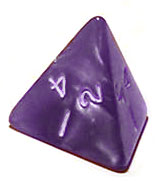 |
| A tetrahedral gaming die |
- Fraternity
- Community
- Esotericism
- History
Each of these aspects or "faces" of Freemasonry, in turn, has three sides:
Fraternity is the relationship that one feels with the Lodge, Freemasons everywhere and the Fraternity as an organization.
Community is the bond of love and charity that one feels toward family and friends, the larger community in which you live and all mankind.
Esotericism is a broad topic, encompassing the symbolic, philosophical and ritualistic aspects of the Craft.
History is the history of the specifically Masonic elements of one's community, the Masonic history of the broader community and the history of the Fraternity itself.
However, like a tetrahedron, these sides are shared, making just 6 true sides in our tetrahedron:
- Fraternity/Community - Brotherly love and leadership
- Fraternity/Esotericism - The spiritual bond of brotherhood
- Fraternity/History - The eternal edifice of the Fraternity
- Community/Esotericism - Sacred duty to mankind
- Community/History - Stewardship of the past and present
- Esotericism/History - The allegories and ritual of Freemasonry and their meanings
As a point of clarification, however, this blog is almost entirely focused on Blue Lodge or Craft Freemasonry. That is, it's not about The Shrine, Scottish Rite or York Rite, fascinating though those are.
Subscribe to:
Posts (Atom)